
INTRODUCING AI HIRA™
AI HIRA™ AI hazard identification and risk assessment software
Every HIRA as sharp as your best panel. It finds the hazard nobody listed, questions every score and pushes controls past PPE – on the register your team already keeps.
AI suggests. Your team decides. Nothing reaches the register until a person accepts it.
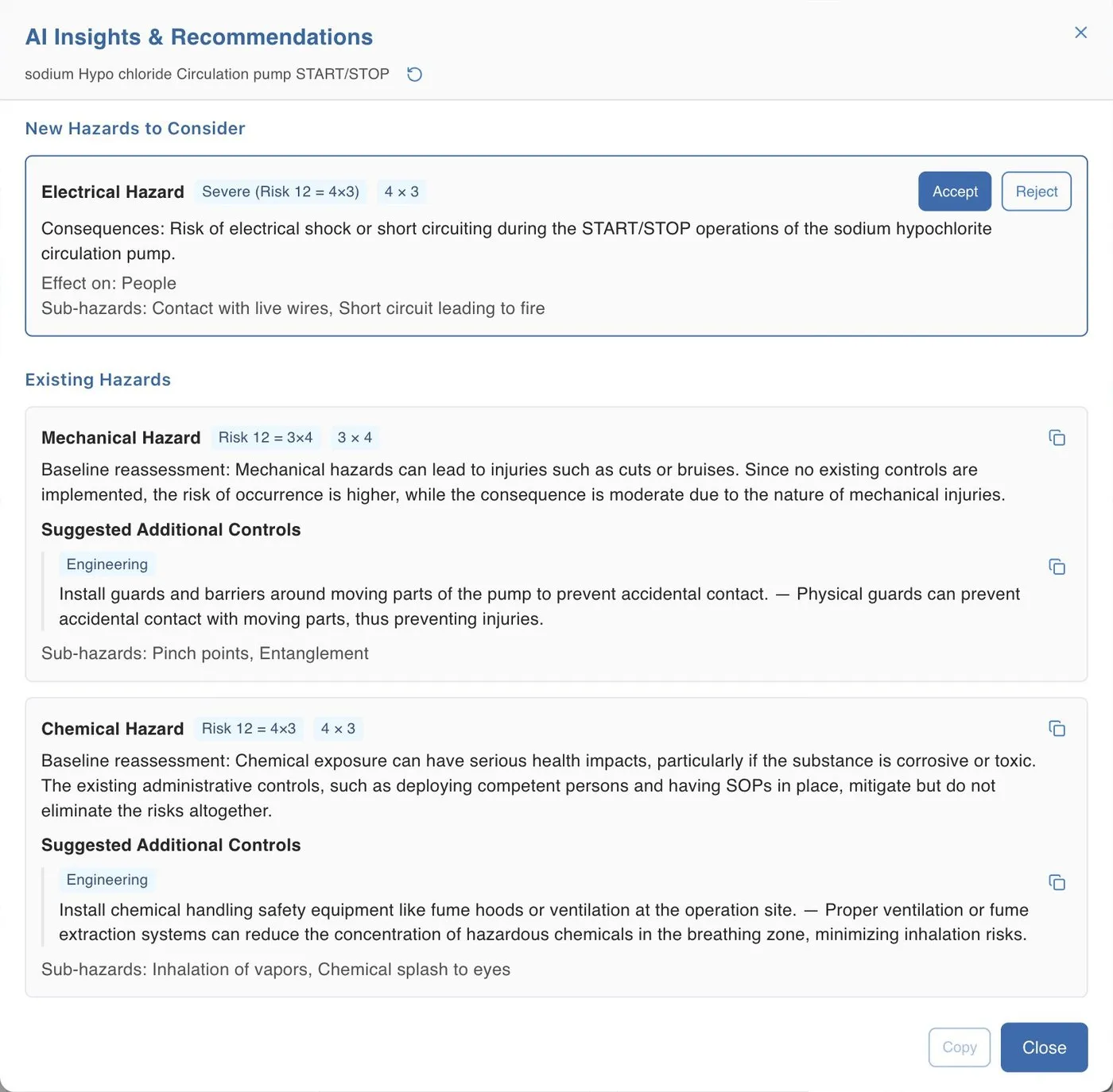
AI HIRA™ · Insights · sodium hypochlorite circulation pump · START/STOP
NEW HAZARD · 12
Electrical shock at START/STOP
A hazard the register did not list.
RE-SCORED · 2 → 12
Chemical exposure
Recorded Low, re-assessed High on your 5×5 matrix.
CONTROL UPGRADED
Guards and barriers on moving parts
An engineering control, not more PPE.
Awaiting acceptance by your reviewer.
REGISTER→INSIGHTS→ACCEPT→ACTIONS→DASHBOARD
Finds the hazard nobody listedQuestions every scorePushes past PPEHuman-approved
What is Sparrow AI HIRA™?
AI HIRA™ is Sparrow’s AI-assisted hazard identification and risk assessment (HIRA) software. It reads the HIRA your team has written, suggests hazards that were missed, re-assesses risk scores on your own 5×5 matrix and suggests stronger controls using the hierarchy of controls. Every suggestion is reviewed and accepted or rejected by a person.
What is HIRA?
HIRA (hazard identification and risk assessment) is how a site lists the hazards in each activity and task step, rates each risk as consequence × probability on a risk matrix, and records the controls that reduce it. ISO 45001 clause 6.1.2 requires it.
KEY FACTS
ProductAI HIRA™ by Sparrow Risk Management Pvt. Ltd.
What it doesFinds missed hazards, re-scores risk, suggests controls up the hierarchy
Risk matrixYour own – for example 5×5 consequence × probability
ControlA person accepts or rejects every suggestion, with a full audit trail
Built forChemicals, pharma, cement, metals, FMCG, energy and engineering
StandardSupports ISO 45001 clause 6.1.2
45 SECONDS
One click. Watch it think.
Your register, the Insights button, and what comes back: a hazard nobody listed, a score that was too low, controls that go further than PPE. Then your reviewer decides – and the dashboard shows where the risk went.
INSIDE AI HIRA™
One HIRA register. A sharper one.
01 · REGISTER
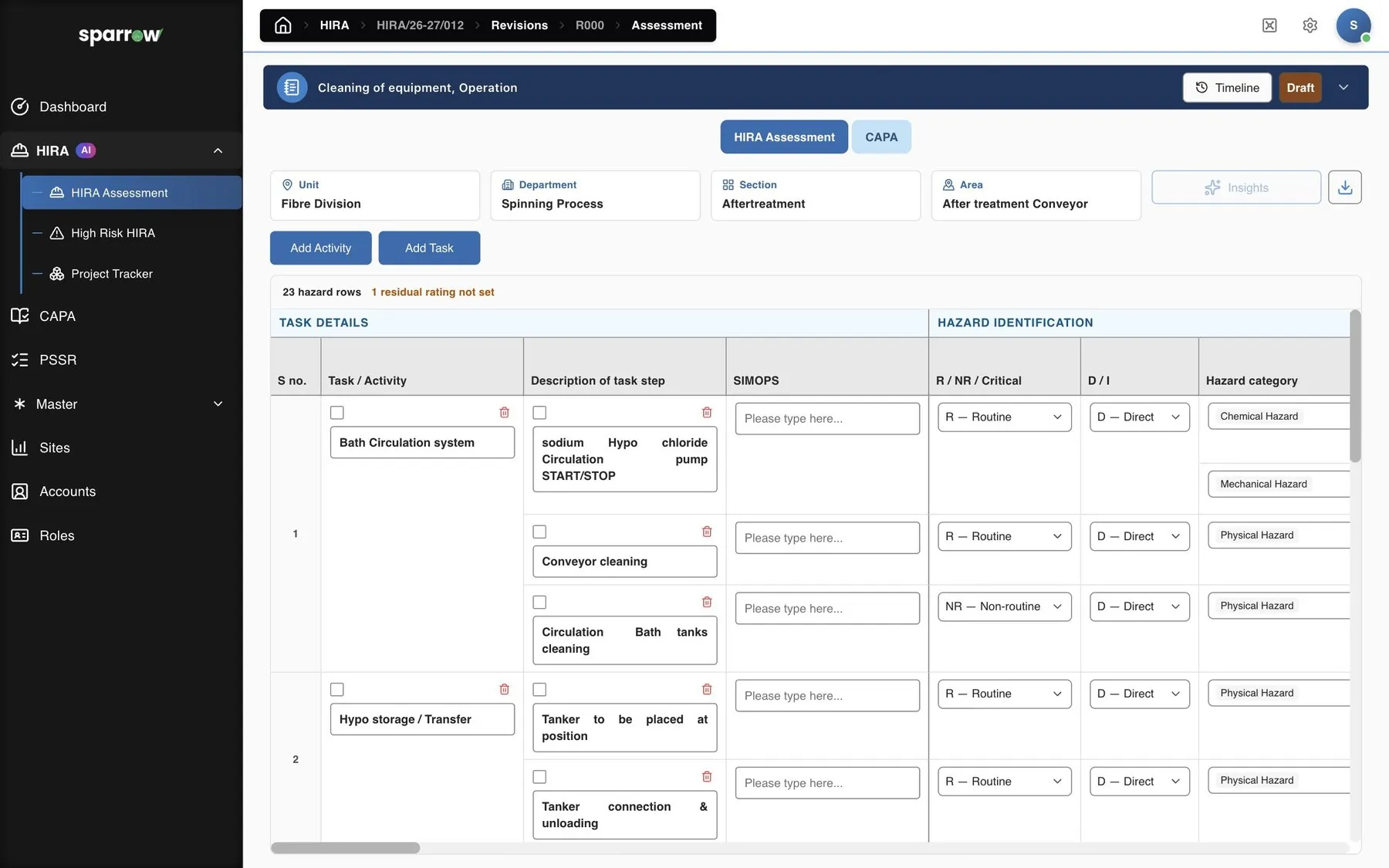
The register your team already keeps
Activities, task steps, hazards, controls and scores – unchanged.

02 · FIND
The hazard nobody listed
Surfaced per task step, with consequences and sub-hazards.
03 · QUESTION
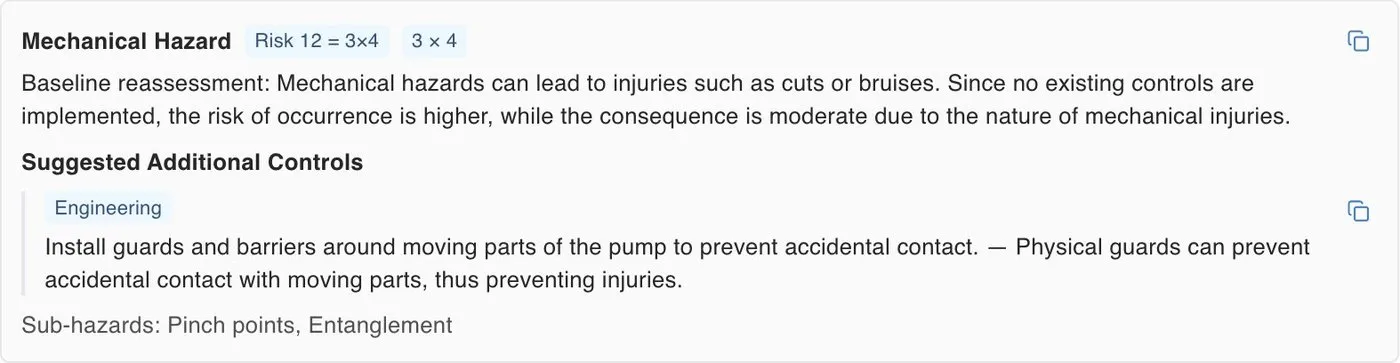
A second opinion on every score
Re-scored on your matrix, with the reason written out.
04 · PUSH
Controls past PPE
Engineering and substitution suggested first.
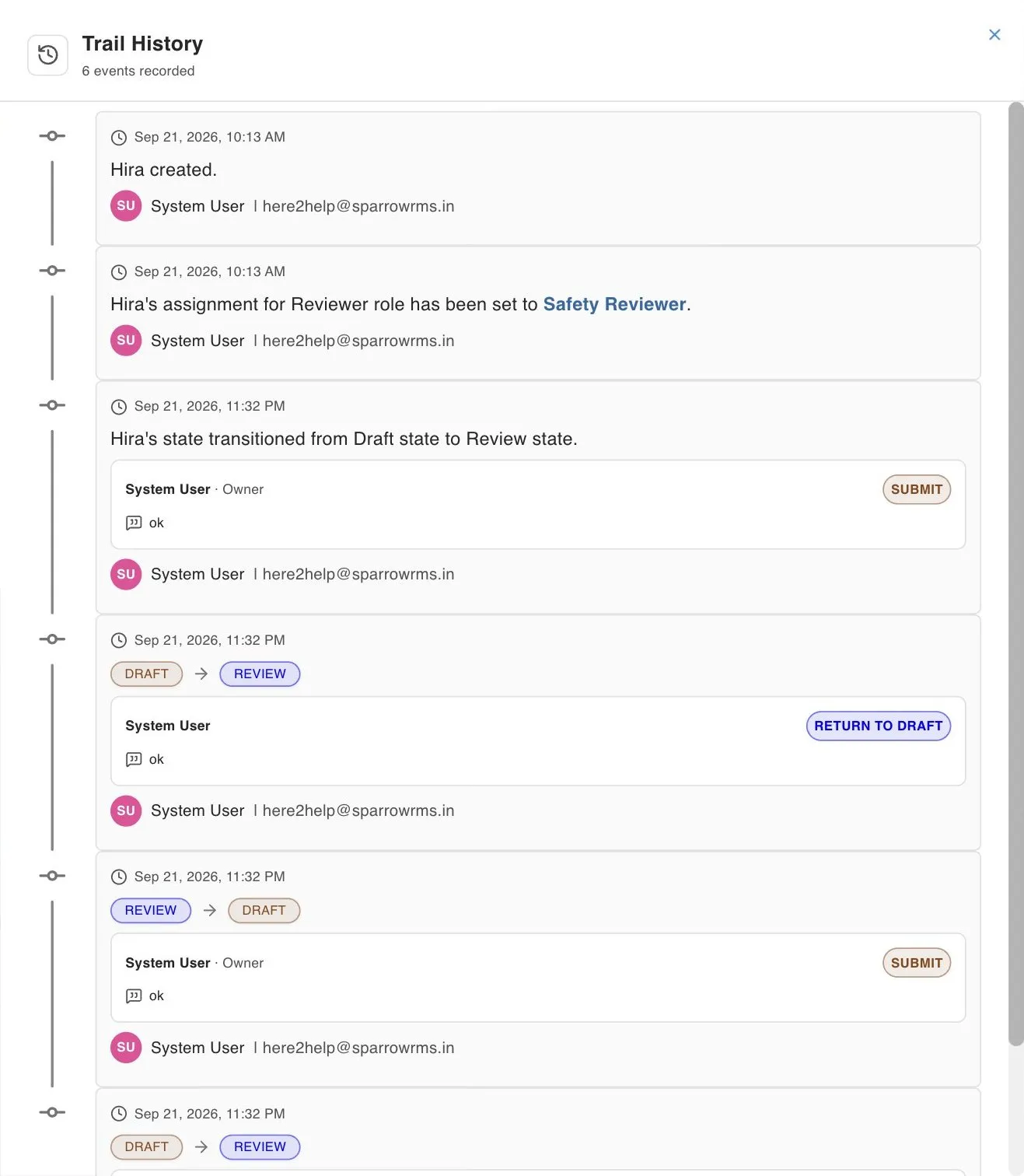
05 · DECIDE
Your reviewer signs
Draft, review and approval on every revision.
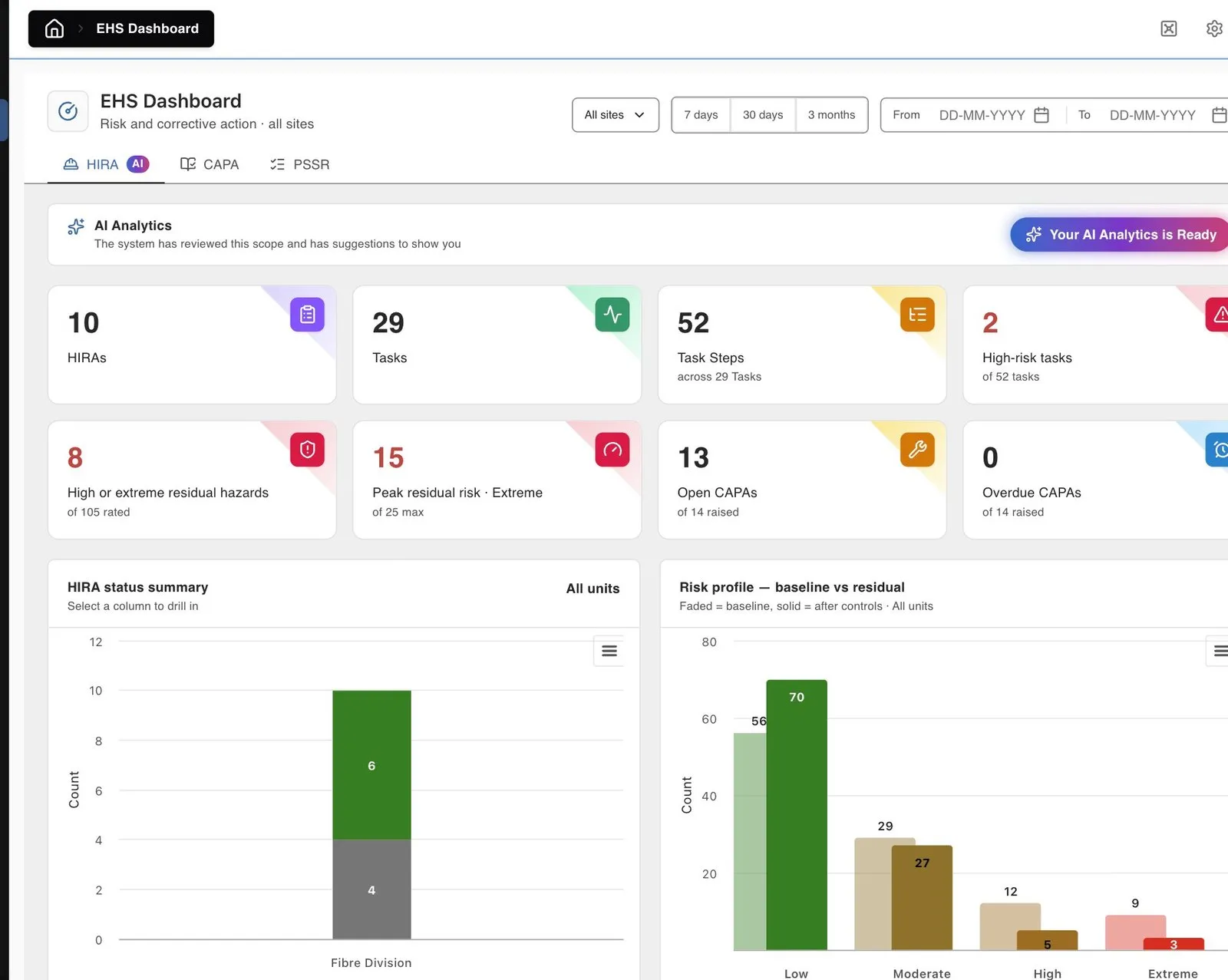
06 · SEE
Where the risk went
Baseline against residual, across every project.
01 · WHY NOW
A HIRA is only as good as the panel that wrote it.
01
The panel changes. The plant doesn’t.
Who sat in the room decides what gets listed. A different team, a busy week or a new site, and whole hazards go missing.
02
Scores settle low.
Copied rows, familiar tasks and existing SOPs pull ratings down. A Low that should be High is the most expensive line in the register.
03
PPE becomes the answer.
Gloves, goggles and training are easy to write. Engineering controls – the ones that remove the hazard – get suggested far less.
02 · THE TURN
Click Insights.
Most HIRA software stops at a template. AI HIRA™ starts with the register your team already keeps. No re-entry, no new forms. One click on a task step, and every hazard, score and control in it gets a second, expert-level review – ready for your team to accept or reject.
AI HIRA™ · HIRA register
03 · THE SCIENCE
How AI risk assessment works: watch it think.
One click on a task step. Four passes before anything is suggested to your team.
01
Reads every hazard row
Activity, task steps, existing controls and current scores – exactly as your team wrote them.
02
Matches global hazard knowledge
Brings the experience of a full expert panel to every task step, so the list doesn’t depend on who was in the room.
03
Re-scores on your 5×5 matrix
Your consequence and probability bands, with a written reason for every change.
04
Pushes controls up the hierarchy
Elimination, substitution and engineering before administrative controls and PPE.
100%
ANALYSED
✓ Analysis complete
04 · NEW HAZARDS
It finds the hazard nobody listed.
On a pump START/STOP step, the register listed mechanical and chemical hazards. AI HIRA™ added the one it missed: electrical shock or short circuit – with its consequences, who it affects and its sub-hazards, scored Severe (12 = 4 × 3).
Per task stepConsequences · effect on · sub-hazardsAccept or reject
05 · A SECOND OPINION ON EVERY SCORE
It questions the risk score, not just the list.
RECORDED BY THE TEAM
2
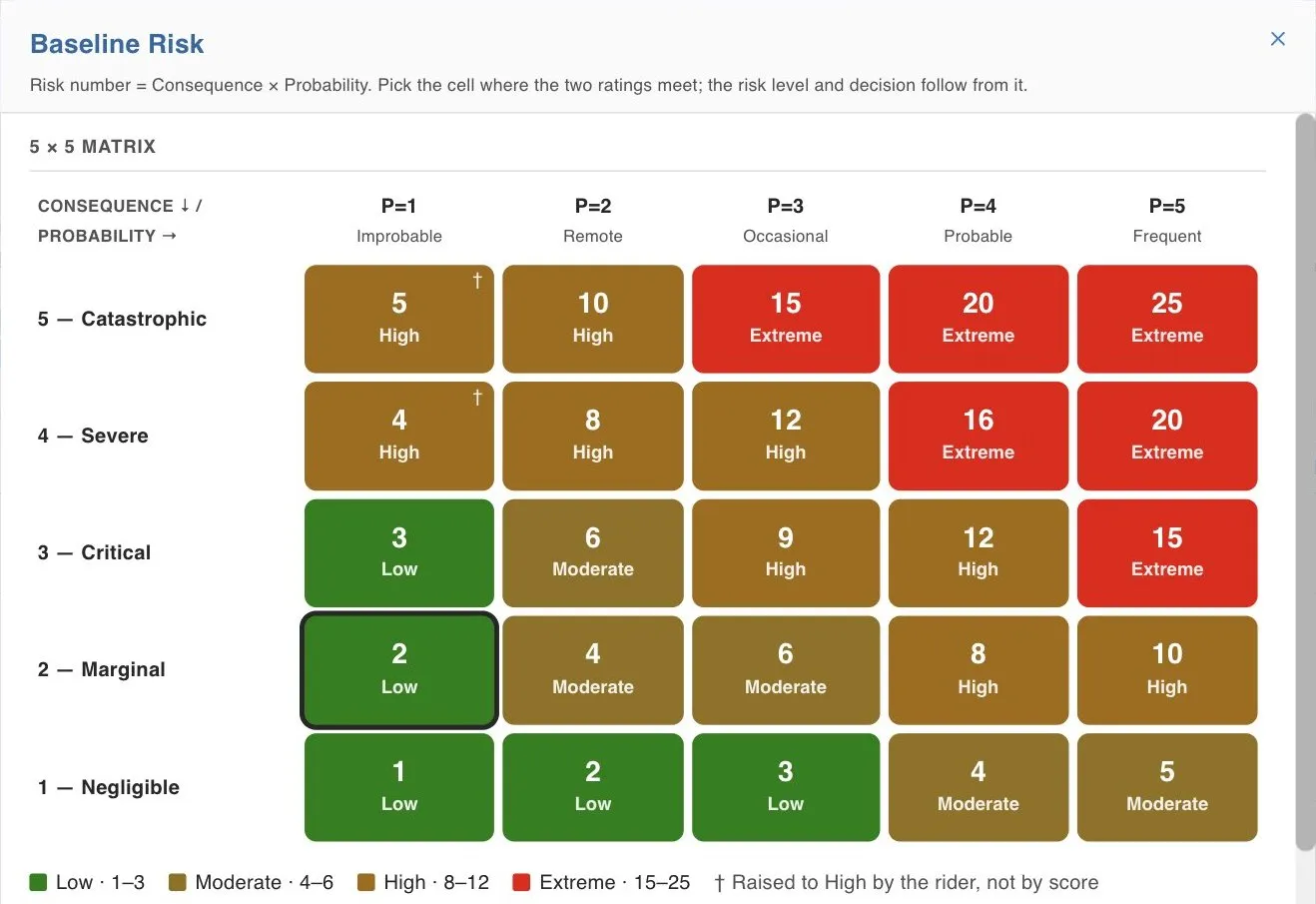
Low · C2 × P1 · Accepted
Chemical hazard on a sodium hypochlorite circulation pump, start/stop. Existing control: competent persons and an SOP.
→
AI HIRA™ RE-ASSESSMENT
12
High · C4 × P3
Corrosive and toxic exposure can be serious. Administrative controls reduce the risk but do not remove it. Suggests ventilation at the point of operation.
Scored on your 5×5 matrix.
Risk number = consequence × probability, on the bands and colours your site already uses. The gap is visible before sign-off – and your reviewer decides.
06 · HIERARCHY OF CONTROLS
It pushes past PPE.
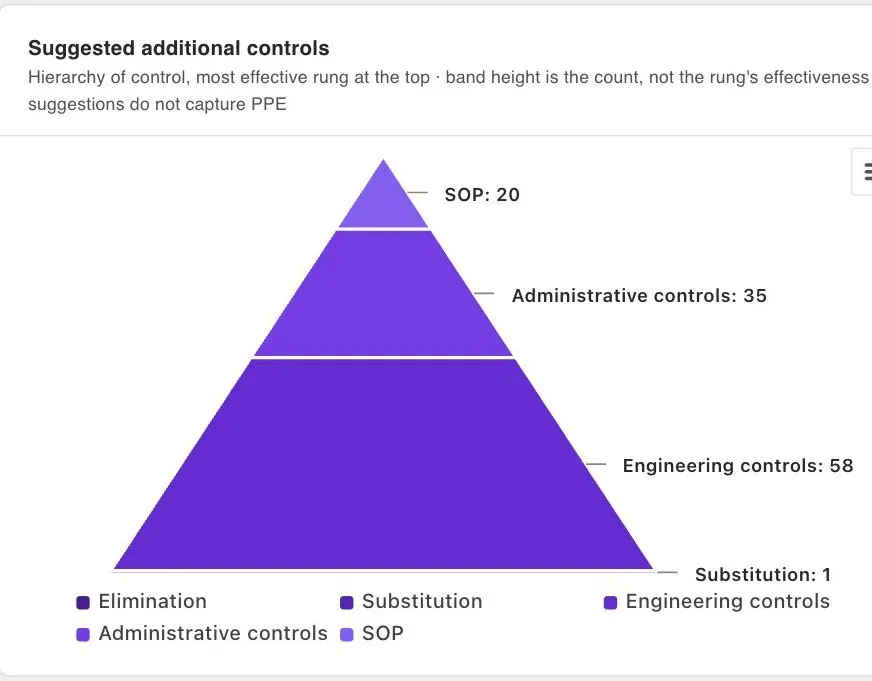
For every hazard, AI HIRA™ suggests additional controls and labels each one by its level – elimination, substitution, engineering, administrative or PPE. Guards and barriers on moving parts. Local exhaust at the point of operation. The controls that remove the hazard come first.
EliminationSubstitutionEngineeringAdministrativePPE
07 · THE PART WE CARE ABOUT MOST
AI suggests. You decide.
01
Nothing auto-filled
Every new hazard and every re-score is accepted or rejected by a person. Rejected suggestions stay on record.
02
Reasons, not verdicts
Each suggestion says why, so a reviewer can disagree with evidence instead of a feeling.
03
Reviewed and signed
Owner and reviewer approval with a full trail – from draft to review to approved – on every revision.
08 · AI ANALYTICS AND DASHBOARDS
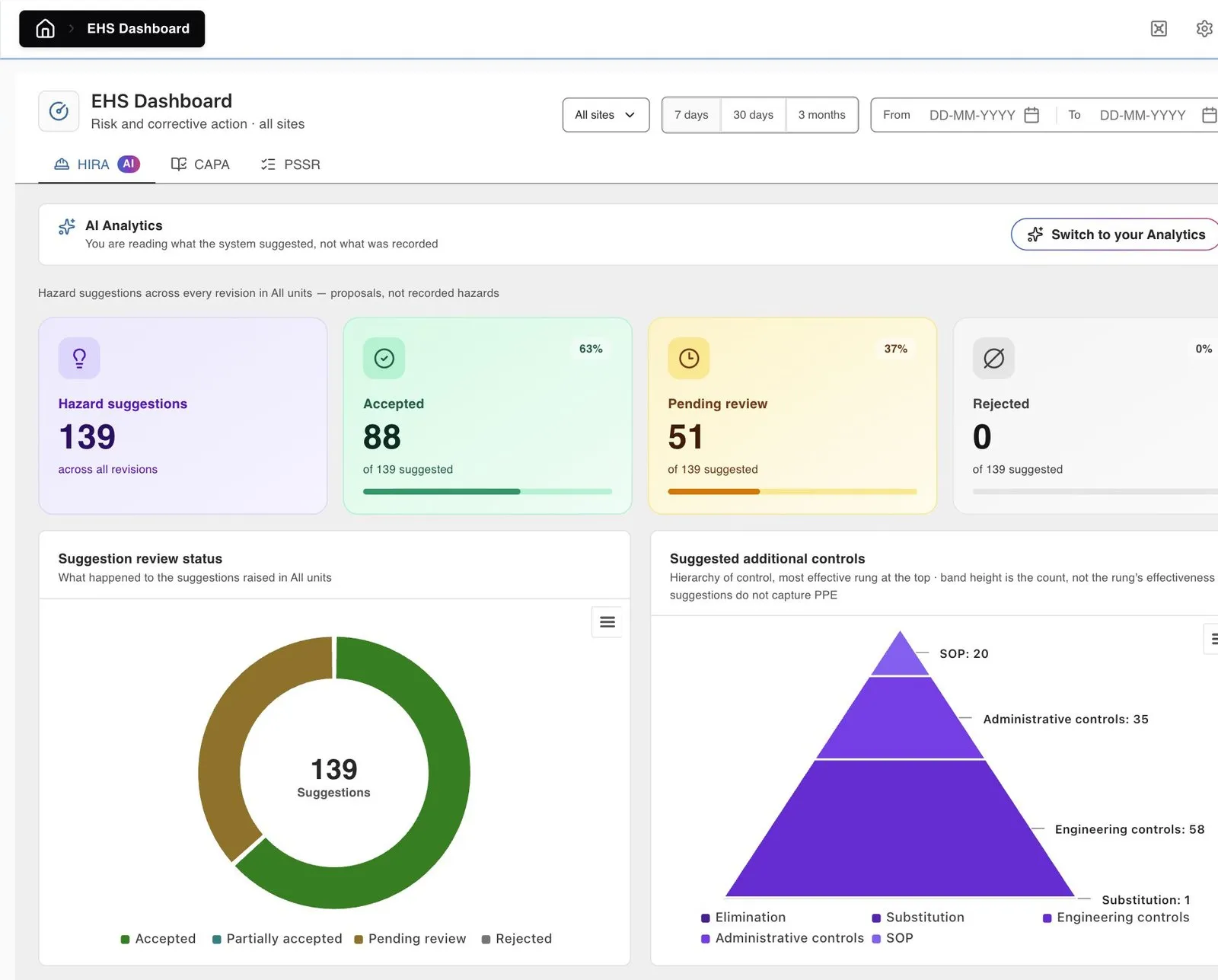
Every suggestion counted. Every risk traced.
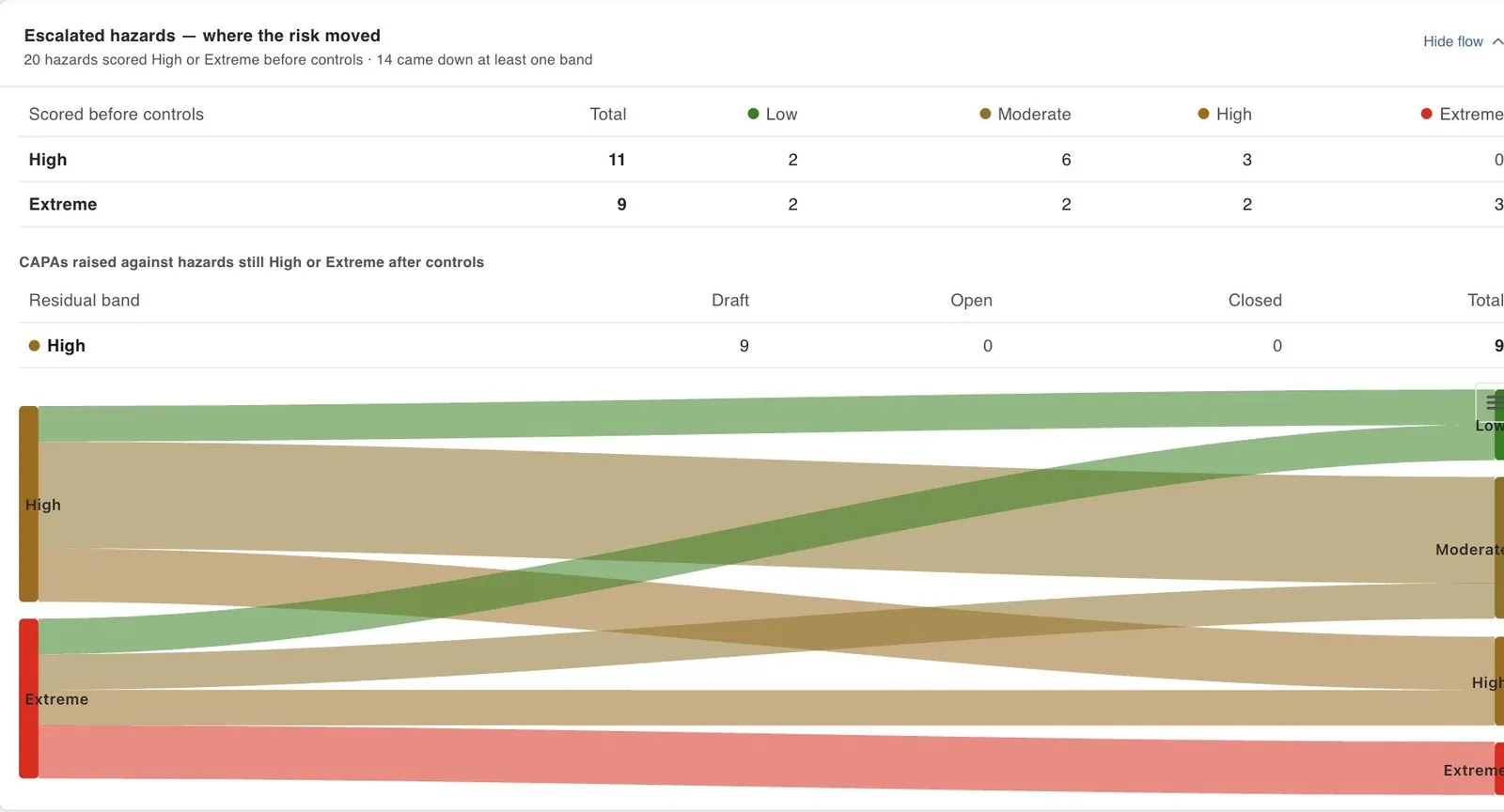
See how many AI suggestions were accepted, are pending or were rejected; how baseline risk compares with residual across sites; and exactly where your High and Extreme risks went once controls were in place.
09 · PART OF SPARROW EHS
From HIRA gap to owned action.
AI HIRA™ is part of Sparrow EHS. It works alongside iHAZOP for process hazard studies, AI PTW for permits to work and incident management, so the hazards you assess are the hazards you control.
HIRA
Projects and trackers
Gaps identified, completed and open, with target dates – per activity and per site.
CAPA
Actions with owners
Accepted controls become tracked corrective and preventive actions.
MOC · PSSR
Change stays assessed
Changes through management of change (MOC) and pre-startup safety review (PSSR) pull the hazards and controls already reviewed.
AI-SiteSense™
A photo from the floor
AI-SiteSense™ site-photo hazard analysis that can feed the same HIRA register.
600+
Industrial clients
AI HIRA™ is built by Sparrow’s process-safety and EHS team, drawing on that work.
BUILT FOR
Chemicals, pharma, cement, metals, FMCG, energy and engineering
Process and manufacturing operations, on your own risk matrix.
SPARROW SAFETY INTELLIGENCE REPORT
The evolution of HIRA: from manual forms to AI analytics
How hazard identification and risk assessment moved from paper registers to digital HIRA and AI.
Bring us one HIRA register.
We'll run AI HIRA™ on a task from your own plant and show you what it finds, what it re-scores and which controls it pushes up the hierarchy.
10 · QUESTIONS, ANSWERED
AI HIRA software FAQs
What is AI HIRA™?+
AI HIRA™ is Sparrow’s AI-assisted hazard identification and risk assessment (HIRA) software. It reads the HIRA your team has written, suggests hazards that were missed, re-assesses risk scores on your own 5×5 matrix and suggests stronger controls using the hierarchy of controls. Every suggestion is reviewed and accepted or rejected by a person.
What does HIRA stand for in safety?+
HIRA stands for Hazard Identification and Risk Assessment. For each activity and task step, a team lists the hazards, rates the risk – usually as consequence × probability on a risk matrix – and records the controls that bring that risk down to an acceptable level. It is the core of the hazard identification and risk assessment that ISO 45001 clause 6.1.2 asks for.
How is it different from a HIRA template or spreadsheet?+
A template records what the team already thought of. AI HIRA™ gives every task step a second, expert-level review: it adds hazards the panel did not list, questions scores that look too low and pushes controls beyond PPE – before the HIRA is signed off.
What is the difference between HIRA and JSA?+
A HIRA covers the routine and non-routine activities of a site or process, scores each hazard on a risk matrix and sets controls for the whole operation. A JSA (job safety analysis) breaks one specific job into steps just before it is done and lists the precautions for that crew. Most sites need both; AI HIRA™ sharpens the HIRA that the JSAs draw on.
Can AI do hazard identification reliably?+
AI is good at consistency – it checks every task step against a wide body of hazard knowledge and does not get tired or skip rows. It cannot see your plant or know local conditions. That is why AI HIRA™ gives a written reason for every suggestion and nothing is added to the register until a competent person accepts it.
Does AI HIRA™ change our register on its own?+
No. Suggestions appear as new hazards to consider, re-assessments and additional controls. Nothing is written to the register until a person accepts it, and every accept, reject and approval is kept in the audit trail.
Which risk matrix does it use?+
Yours. AI HIRA™ scores on the consequence and probability bands configured for your organisation – for example a 5×5 matrix where the risk number is consequence × probability – and shows the reason for every change.
Does it replace our HIRA team or workshop?+
No. It makes every team as sharp as your best panel. Your people still own the activities, the scores and the decisions; AI HIRA™ brings global hazard knowledge and consistency to every task step.
How does it use the hierarchy of controls?+
Each suggested control is labelled by its level – elimination, substitution, engineering, administrative or PPE – and AI Analytics shows how your controls are spread across the hierarchy, so you can see when a site is leaning on PPE.
Which industries is it built for?+
Process and manufacturing operations – chemicals, pharma, cement, metals, FMCG, energy and engineering. It is built by Sparrow’s process-safety and EHS team, drawing on work with 600+ industrial clients.
Is AI HIRA™ available for plants in India?+
Yes. Sparrow is headquartered in Gurugram with teams in Mumbai, Bengaluru, Kolkata and Dubai, and AI HIRA™ is built for EHS and process-safety teams at Indian manufacturing and process plants. It is web-based, so multi-site organisations can run it across every location.
Does it help with ISO 45001?+
It supports the hazard identification and risk assessment work that ISO 45001 clause 6.1.2 asks for, with documented reasons, reviews and an audit trail. Certification decisions remain with your auditor.
What happens after a suggestion is accepted?+
It becomes part of the HIRA. Gaps are tracked per activity with owners, completion and target dates, and controls can flow into CAPA. Dashboards show baseline against residual risk and where High and Extreme risks moved.
Does it check whether controls are working on the plant in real time?+
Not in this edition. AI HIRA™ reviews the hazards, scores and controls in your HIRA. Live verification of controls through plant integration is on Sparrow’s roadmap.
Is our HIRA data kept confidential?+
Your data is used only for your assessments. Talk to us about hosting, retention and data-handling requirements – we cover them in every demo.
How do we get started?+
Book a demo. We will run AI HIRA™ on a task from your own HIRA and walk your team through the insights, re-scores, controls and dashboards. Use the Book a Demo button or write to rms@sparrowrms.in.