
The Safety Intelligence Gap
The Safety Intelligence Gap
From Paper Clipboards to Connected Command Centres: A Manufacturing Leader’s Guide to Digital EHS and Process Safety Integration on Sparrow EHS Software
The Boardroom Question
When the CFO Asks What the Money Is Buying
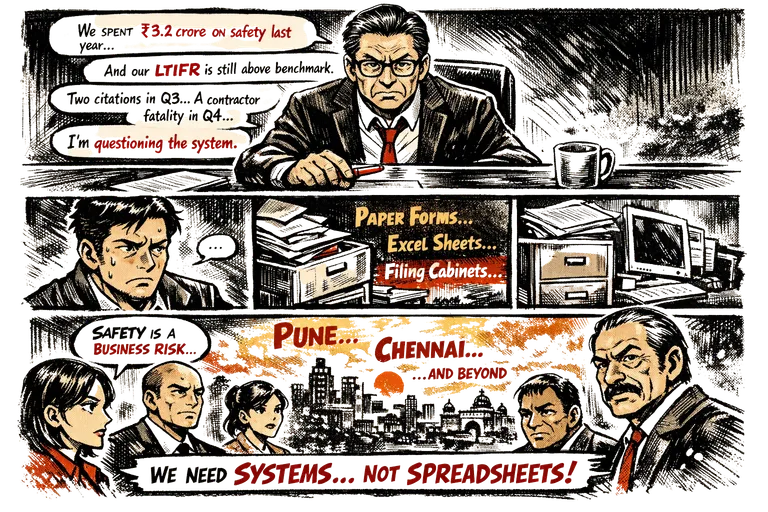
The question came at the end of a board safety review. The CFO set down his pen.
“We spent ₹3.2 crore on safety last year, he said. “Our LTIFR is still above benchmark. Two regulatory citations in Q3. A contractor fatality in Q4. I’m not questioning the team’s commitment. I am questioning the system.”
The EHS Director didn’t have a clean answer. Not because the safety programme was poorly run — it wasn’t. The team was diligent, committed, and experienced. But the infrastructure they operated on was built for a different era: paper forms, shared drives, Excel trackers, and a filing cabinet that held the compliance fate of a 1,400-person facility.
That conversation — versions of which are playing out in boardrooms from Pune to Chennai to Ahmedabad — marks a turning point. Safety is no longer a function that operates in isolation. It is a material business risk, a governance obligation, and an ESG disclosure requirement. Business risks demand systems, not spreadsheets.
The Evidence
What the Data Actually Says About the Cost of Paper EHS
Every figure in the table below is drawn from a named, published source. No numbers are estimated or modelled by the authors. Indian-context costs where referenced in narrative are converted at prevailing INR/USD rates and noted as approximate.
| Documented Cost Benchmark | Verified Figure | Context | Source |
|---|---|---|---|
| Cost per medically-consulted workplace injury | USD 43,000 per injury | Includes wage loss, medical, admin; excludes indirect costs | NSC Injury Facts, 2023 |
| Total indirect cost multiplier | Indirect costs = 1x—2.12x direct costs | Per OSHA Safety Pays and NSC statistics. Total injury cost: USD 86,000–$134,000 for a USD 43,000 direct-cost injury | OSHA Safety Pays; NSC via ASSE White Paper, 2002 |
| Cost per work-related death | USD 1,460,000 per fatality | 4,543 preventable work deaths in US in 2023; 4.07 million medically consulted injuries | NSC Injury Facts, 2023; BLS CFOI |
| Safety investment return | $4—$6 saved per $1 invested | OSHA Office of Regulatory Analysis; VPP participants average 50%+ below industry injury rates | OSHA; ASSE White Paper, 2002; Safety+Health Magazine, 2014 |
| LOTO violations — US (FY2023) | 2,532 citations; USD 20.7M in penalties | 29% rise from 2022; LOTO moved to #5 most cited in FY2024; hazardous energy caused 190 deaths in 2023 | Grace Technologies study, 2024; OSHA Top 10 FY2023–24; BradyID / BLS 2023 |
| India: Avg factory fatalities per year (2017–2020) | 1,109 deaths/year avg. (~3/day) | Registered factories only; underreporting acknowledged. NIFTY-500 alone: 463 fatalities in FY2023 | DGFASLI via IndiaSpend RTI, Jan 2023; IiAS Workplace Safety Report, July 2024 |
| India: Workplace injuries trend (NIFTY-500, FY2023) | 10,733 injuries; up 8.5% YoY; high-consequence injuries up 33% | Direct employees only; excludes contractors. Actual numbers higher. SEBI BRSR now mandates disclosure | IiAS India Workplace Safety Report, July 2024 |
For the CFO Per OSHA’s Safety Pays methodology: a single USD 43,000 direct-cost injury generates USD 86,000–134,000 in total cost once the indirect multiplier is applied. At a 5% operating margin, one injury requires USD 1.7–2.7 million in additional revenue to break even. Source: OSHA Safety Pays Estimator; NSC Injury Facts 2023.
A Story From The Shop Floor
The Incident That the Procedure Could Not Prevent
The investigation report was 47 pages long. A maintenance technician at a steel fabrication facility had followed every step of the laminated LOTO procedure attached to a conveyor system. He isolated every energy source listed on the card.
The card had been printed fourteen months earlier. A hydraulic circuit added during a capacity expansion was not on it. The engineering change had been documented in the project file. The LOTO procedure had not been updated. No system existed to connect the two. The technician survived because a colleague hit the emergency stop.
This is not an isolated failure. From October 2022 to September 2023, OSHA recorded 2,532 LOTO citations — a 29% increase from the prior year — with USD 20.7 million in penalties. LOTO moved to the #5 most-cited standard in FY2024. In 2023, hazardous energy caused 190 workplace deaths. (Sources: Grace Technologies study, 2024; OSHA Top 10 FY2023–24; BLS CFOI 2023.)
The structural failure is clear: paper LOTO procedures are static. Manufacturing operations are not. Every equipment change, capacity expansion, or process modification creates a gap between what the laminated card says and what the machine actually requires.
The Platform
Nine Modules, One Connected Safety Intelligence System
A modern EHS platform is modular — each capability targets a specific vulnerability in your risk chain. When deployed on a shared data layer, a near-miss captured in Incident Management can auto-trigger a HIRA review, update a permit condition, and schedule a training refresher. The table below maps each module to its documented failure mode and evidence basis — not vendor-claimed percentages, but published sources.
| Module | Paper Failure Mode | What Software Changes | Evidence Basis | Stakeholder |
|---|---|---|---|---|
| 🔍 Audit Mgmt | Findings filed; repeat non-conformances persist | Mobile checklists, auto-assigned CAPAs, searchable evidence repository | General EHS implementation literature; no single RCT | COO / EHS Head |
| ⚙️ Process Safety (PSM) | Stale procedures; MOC approvals stall in email | Linked MOC workflows, integrity schedules, live SOP versioning | Baker Panel 2007: PSM documentation failure cited as root cause of Texas City | Plant Head / PSM Mgr |
| 📋 Permit to Work | SIMOPS conflicts undetected on paper | Live permit map, automated conflict flags, stepwise digital approvals | UK HSE: PTW failures implicated in majority of maintenance fatalities in process industries | Operations / Maintenance |
| 🏗️ Contractor Mgmt | Credentials expire undetected; induction inconsistent | Portal-based prequalification, auto expiry alerts, performance scorecards | IiAS 2024: FY23 data excludes contractors — actual fatalities higher than disclosed | Procurement / EHS |
| 🎓 Training Mgmt | Certification lapses invisible until an incident | Role-based matrix, auto expiry alerts, digital training, competency analytics | OSHA enforcement: $782K LOTO training fine (Eau Claire, WI) — improper training cited | HR / EHS / Sustainability |
| 🚨 Incident Mgmt | Near-misses underreported; no systemic RCA | Mobile capture, guided RCA, trend dashboards, leading indicators | NSC 2023: 27%+ workers don't report own injuries; Bird (1966): ~600 near misses precede each recordable | CXO / EHS Head |
| 🔧 PSSR | Open items skipped under schedule pressure | Enforced digital approvals; startup blocked until all items resolved | Baker Panel / CSB: premature startup a factor in major process incidents | Engineering / Safety |
| ⚠️ HIRA | Assessor-dependent; context-blind forms | Structured hazard libraries, consistent scoring, incident linkage | CCPS: poor risk assessment quality a root cause in major accident investigations | EHS / Risk Manager |
| 🔒 LOTO | Laminated cards not updated after equipment changes | Step-enforced mobile workflows, auto-retire stale procedures, live lockout map | OSHA FY2023: 2,532 citations; FY2024 rose to #5 most cited; 190 hazardous energy deaths in 2023 | Maintenance / EHS |
Note: Specific percentage improvement figures cited in EHS vendor literature (e.g. ‘↓70% audit prep time’) are vendor-reported and vary significantly by implementation. This table references published failure modes and investigation findings rather than vendor-claimed KPIs.
The Decision Framework
Where CXOs, EHS Heads, and Sustainability Leaders Should Begin
She didn’t defend the budget. She reframed the question.
“Which of these costs,” she told the CFO, placing a version of the data table in front of him, “would you like to keep absorbing?”
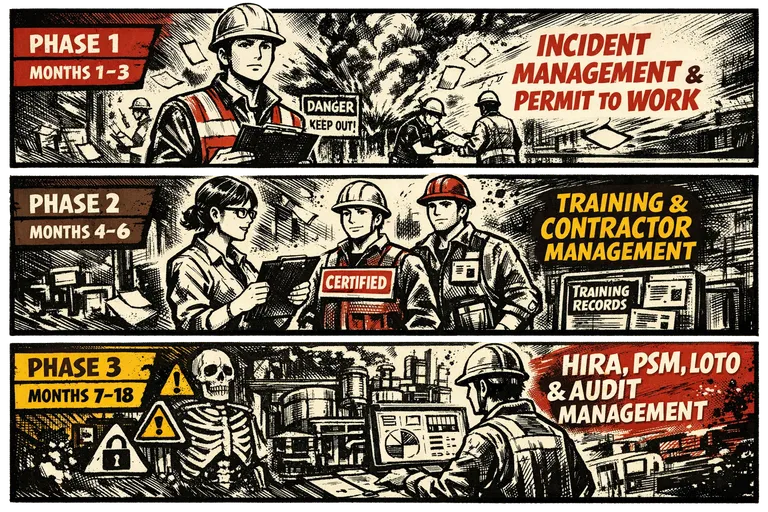
The platform was approved within two weeks. Implementation followed a risk-prioritised sequence — the approach most manufacturing organisations find delivers the fastest visible ROI and the clearest board-level narrative:
- Phase 1 (Months 1–3): Incident Management and Permit to Work — addresses the two highest-frequency documentation failure modes and creates immediate leading indicator visibility for the board
- Phase 2 (Months 4–6): Training Management and Contractor Management — closes the credential and induction gaps that regulators and auditors examine first, and that IiAS data identifies as systematically underreported
- Phase 3 (Months 7–18): HIRA, PSM, PSSR, LOTO, and Audit Management — completes the systematic risk framework and integrates the operational technology layer described in the following section
📊ESG & BRSR dimension SEBI’s BRSR framework — mandatory for India’s top 1,000 listed companies since FY2022-23 — requires explicit safety and health data disclosure. Integrated EHS software feeds incident rates, training coverage, contractor safety performance, and near-miss data directly into BRSR and GRI reporting, eliminating the separate data-gathering effort sustainability teams currently carry manually. Source: SEBI BRSR Framework, 2021.
Process Safety ⇲ & Operational Technology
The Last Frontier: Integrating PLC/DCS Real-Time Data with Process Safety Management
- What CCPS, IEC 61511, ANSI/ISA-18.2, and OSHA 29 CFR 1910.119 require — and where the gap between the control room and the safety management system costs lives
- In most manufacturing facilities running hazardous processes, there are two parallel worlds that rarely speak to each other.
- The first world is the control room: a DCS historian logging thousands of process variables every second, a PLC executing safety logic in milliseconds, a Safety Instrumented System standing guard over critical trip functions. This world runs on real-time data — pressure, temperature, flow, level, valve position — and it is, by any measure, the richest source of process safety intelligence in the facility.
- The second world is the PSM programme: the HAZOP binders, the PHA reports, the mechanical integrity schedules, the MOC records, the SIL verification documents. This world runs on paper — or, at best, on disconnected spreadsheets. It is updated periodically, reviewed annually, and consulted primarily when something has already gone wrong.
- The gap is not a technology problem. It is a governance architecture problem. And every major process safety standard — CCPS RBPS, IEC 61511, ANSI/ISA-18.2, and OSHA 29 CFR 1910.119 — has something specific to say about how that gap must be closed.
The Baker Panel investigation (2007) found that process safety information — including data from instrumented systems — was not being effectively used to manage risk at BP Texas City. The DCS had recorded every deviation. Nobody was systematically looking at it through a process safety lens.
The Regulatory Architecture
What the Standards Actually Require
The requirement to integrate OT data with PSM is not an emerging best practice — it is embedded in the foundational standards framework governing process industries globally:
| Standard | Body | Mandate Relevant to PLC/DCS | CCPS RBPS Elements |
|---|---|---|---|
| OSHA 29 CFR 1910.119 | US OSHA | PSI must document that safety systems — including interlocks — comply with RAGAGEP. Mechanical Integrity §(j) mandates written procedures covering instrumented protective systems | PSI §(d); MI §(j); MOC §(l) |
| IEC 61511 / ISA 84 | IEC / ISA | Full SIS lifecycle governance. SIS must be independent of BPCS/DCS. SIL verified per SIF. 2016 Ed. added mandatory Functional Safety Management System. OSHA-endorsed RAGAGEP | Asset Integrity (E10); PSI (E6); MOC (E13) |
| IEC 61508 | IEC | Master functional safety standard for E/E/PE safety-related systems. IEC 61511 references it for PLC-based SIS logic solver hardware and software requirements | Functional safety of SIS hardware/software |
| ANSI/ISA-18.2 (2016) | ISA / IEC 62682 | Alarm lifecycle management. Master Alarm Database mandatory. Acceptable rate: 1-2 alarms/operator/10 min. Flood: >10 alarms/10 min = performance failure. OSHA-accepted good engineering practice | Conduct of Operations (E14); Operating Procedures |
| CCPS RBPS — 20 Elements | AIChE / CCPS (2007) | E10: ongoing integrity of all instrumented systems. E13: any change to PLC/DCS logic, SIS setpoints, or control configuration must pass formal MOC before implementation | E6 Process Knowledge; E10 Asset Integrity; E13 MOC; E14 Ops |
| API RP 754 (2016, 2nd Ed.) | API / CCPS | SOL exceedances detectable via DCS historians = Tier 3 PSE leading indicators. Establishes Tier 1-4 process safety performance indicator framework | Process Safety Metrics; Leading Indicators; SOLs |
| ISA-TR84.00.09-2017 | ISA | Cybersecurity integration with functional safety lifecycle for SIS and BPCS. Requires coordination between IEC 61511 and ISA/IEC 62443 OT cybersecurity standards | SIS Cybersecurity ; OT Network Integrity |
📋OSHA’s formal position on IEC 61511In a March 2000 letter to ISA, OSHA formally endorsed IEC 61511/ISA 84 as a Recognised and Generally Accepted Good Engineering Practice (RAGAGEP) for safety instrumented systems, stating that non-conforming SIS may violate the General Duty Clause even for processes not covered under PSM. Source: OSHA Letter of Interpretation to ISA, March 23, 2000.
The Architecture
Three Control Layers, One Governance Framework
Layer 1 — The Basic Process Control System (BPCS / DCS)
The DCS generates the continuous process historian: every measured variable, timestamped, at second-level resolution. Under ANSI/ISA-18.2 (2016) — adopted internationally as IEC 62682 — the DCS alarm system must be governed by a lifecycle management framework from philosophy through rationalisation, implementation, monitoring, and audit. The standard establishes a performance benchmark: acceptable alarm rate is approximately 1–2 alarms per operator per 10 minutes. Alarm floods exceeding 10 alarms per 10-minute period are defined as a performance failure requiring formal investigation. For PSM purposes, the DCS alarm historian is a Tier 3 and Tier 4 process safety performance indicator database under API RP 754.
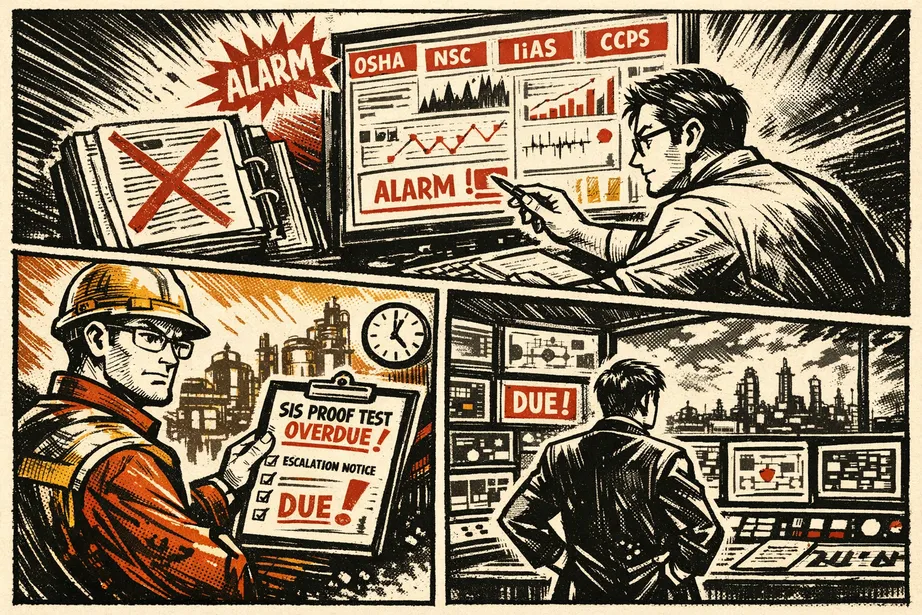
⚠️The alarm management gap ANSI/ISA-18.2 requires a Master Alarm Database documenting cause, consequence, recommended response, and time-to-respond for each alarm. Unmanaged DCS alarm systems were cited in the Buncefield explosion (2005) and multiple CSB investigations. They are not merely an operational nuisance — they are a documented PSM compliance failure under OSHA’s RAGAGEP framework.
Layer 2 — The Safety Instrumented System (SIS / ESD)
The SIS is the protection layer of last resort — governed by IEC 61511 (process sector) and IEC 61508 (hardware/software), both OSHA-endorsed as RAGAGEP. The central requirement of IEC 61511 is independence: the SIS must be physically separate from the BPCS in sensors, logic solvers (safety PLCs), and final elements. The 2016 second edition added an explicit requirement for a Functional Safety Management System — not just SIL-certified hardware, but a documented management system with competency requirements for all personnel in the SIS lifecycle.
Critical implication: PSM software integration with DCS historians must use read-only data feeds. Any write-back pathway from the PSM system into the DCS or SIS would compromise the SIS independence requirement of IEC 61511 and violate the cybersecurity integration requirements of ISA-TR84.00.09-2017.
Layer 3 — The PSM Governance System
OSHA 29 CFR 1910.119 requires that Process Safety Information include documentation of all safety systems, and that equipment comply with RAGAGEP. Mechanical Integrity (§1910.119(j)) mandates written procedures for ongoing integrity of instrumented protective systems with inspection frequencies meeting RAGAGEP. OSHA’s compliance guidance notes that a single valve change can affect eleven PSM elements simultaneously — interdependency that paper-based systems are structurally incapable of tracking in real time.
The Integration Model
What Real-Time OT Data Enables Across CCPS RBPS Elements
When PLC and DCS data is connected — via read-only feeds that preserve SIS independence — to the PSM software layer, six CCPS RBPS elements transform from periodic documentation exercises into continuous, evidence-based risk management:
| CCPS RBPS Element | Real-Time OT Source | What the Data Reveals | PSM Software Action | Standard Ref. |
|---|---|---|---|---|
| E6 — Process Knowledge | DCS historian; P&ID live tags | Actual parameters vs. design intent; SOL drift | Flag SOL exceedances as Tier 3 PSE leading indicators; update PSI documentation | API RP 754; OSHA §1910.119(d) |
| E10 — Asset Integrity | PLC/DCS status tags; vibration, temp, pressure sensors | Equipment degradation signals before loss of | Trigger inspection work orders; update ITPM schedules | CCPS RBPS; OSHA §1910.119(j); IEC 61511 |
| E11 — Hazard Identification | DCS alarm historian; SIS trip records; SOL | Process deviations feeding HAZOP revalidation | Auto-link alarm events to active HIRA/HAZOP records | CCPS RBPS; API RP 754 Tier 3 & 4 |
| E13 — MOC | PLC config change logs; SIS bypass records; DCS setpoint history | Unauthorised or undocumented control system changes | Block unauthorised changes; enforce MOC before any setpoint modification | OSHA §1910.119(l); CCPS RBPS E13 |
| E14 — Conduct of Operations | DCS operator logs; alarm acknowledgement; HMI history | Alarm flood events; response times; procedure deviations | Identify performance gaps; trigger retraining; link to procedure review | ISA-18.2 (2016); CCPS RBPS E14 |
| E16 — Incident Investigation | DCS/SIS event logs and historians (minute-by-minute) | Sequence of events preceding incidents; exact RCA timeline | Auto-retrieve and lock historian data on incident trigger | OSHA §1910.119(m); CCPS RBPS E16 |
🔑The read-only integration principleIEC 61511 requires SIS independence from the BPCS. PSM software integration must therefore use read-only data feeds — typically from the DCS process historian via a DMZ-based replication layer — that extract data without creating any write-back pathway. This satisfies both the functional safety architecture requirement of IEC 61511 and the cybersecurity integration requirement of ISA-TR84.00.09-2017. Vendors claiming bidirectional DCS integration should be challenged on their IEC 61511 compliance posture.
The Board-level Summary
What This Means for the CXO, EHS Head, and Plant Manager
The EHS Director’s answer to the CFO was eventually approved — not on the basis of vendor brochures, but on the basis of documented evidence: NSC cost data, OSHA violation statistics, IiAS India safety findings, and CCPS guidance. The numbers told a story the safety binder never could.
For the EHS Director: the HAZOP is no longer a point-in-time document in a binder. It is a living risk model, continuously informed by what the DCS is actually recording — flagged, updated, and actionable every time an alarm fires on a covered deviation scenario.
For the Plant Manager: the SIS proof test is not a scheduled task vulnerable to production pressure. It is a documented, timestamped compliance obligation — with automated escalation when overdue — as visible to the board as the injury rate.
For the CXO: the control room — which has always been the richest source of process safety intelligence in the facility — is finally connected to the management system that is supposed to use that data.
CCPS identified that the most effective barrier to catastrophic process incidents is not more hardware — it is organisations that systematically learn from what their own processes are telling them. The DCS has always been talking. The question is whether your PSM system is listening.
Deep Technology | Consulting | Solutions
Comments are closed.