
The Architecture of Operational Coherence Closing the EHS Visibility Gap for WEF Lighthouse Excellence
The Architecture of Operational Coherence: Closing the EHS Visibility Gap for WEF(World Economic Forum) Lighthouse Excellence
Closing the EHS Visibility Gap for WEF (World Economic Forum) Lighthouse Excellence
Situation: The Structural Fault Line
In 2025, a flagship Tier-1 automotive manufacturing facility located in South Asia, producing precision drivetrain components, initiated a formal evaluation for WEF Global Lighthouse Network designation. The South Asian facility, operating 14 production lines and managing over 1,200 shop-floor personnel, had no outstanding enforcement actions, a lost-time injury rate below industry median, and a sustainability reporting programme aligned to GRI standards. On every conventional EHS scorecard, it was performing
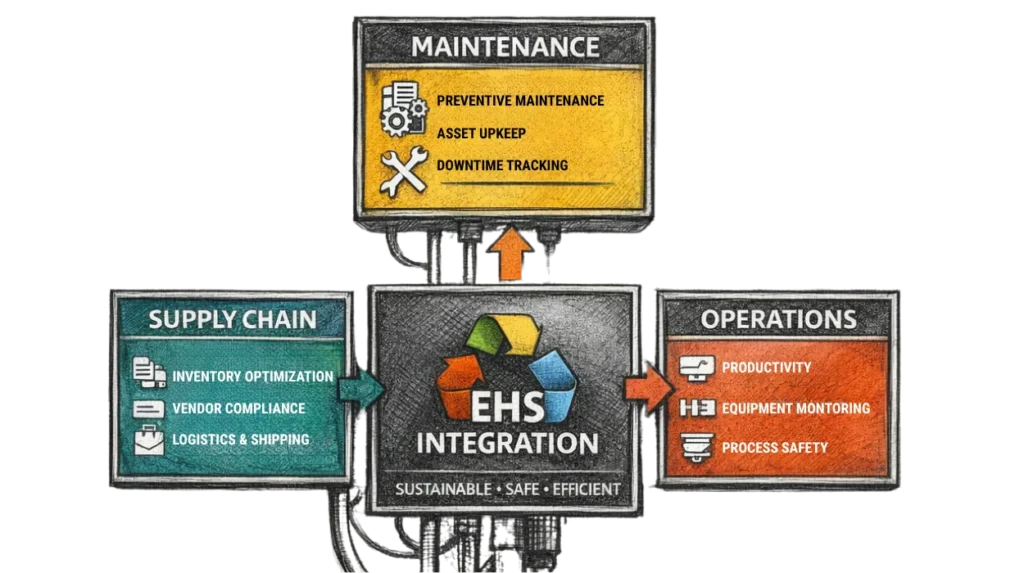
The WEF (World Economic Forum) evaluation framework does not assess EHS in isolation. It evaluates operational coherence—the degree to which safety, sustainability, productivity, and workforce management function as a unified system rather than parallel programs. Yet, when assessors examined the facility’s legacy data architecture, they uncovered a fragmented reality. As the site’s own EHS lead later described it: “We had seventeen versions of the same factory, none of which agreed.”
|
Legacy Architecture (The Baseline) |
Lighthouse-Level Integration (The Target State) |
|---|---|
|
EHS data isolated in spreadsheets.
|
A Single Digital Truth:
Live operational data accessible at every level of the organization. EHS, production, maintenance, and sustainability metrics are fully visible and actionable on one integrated platform. |
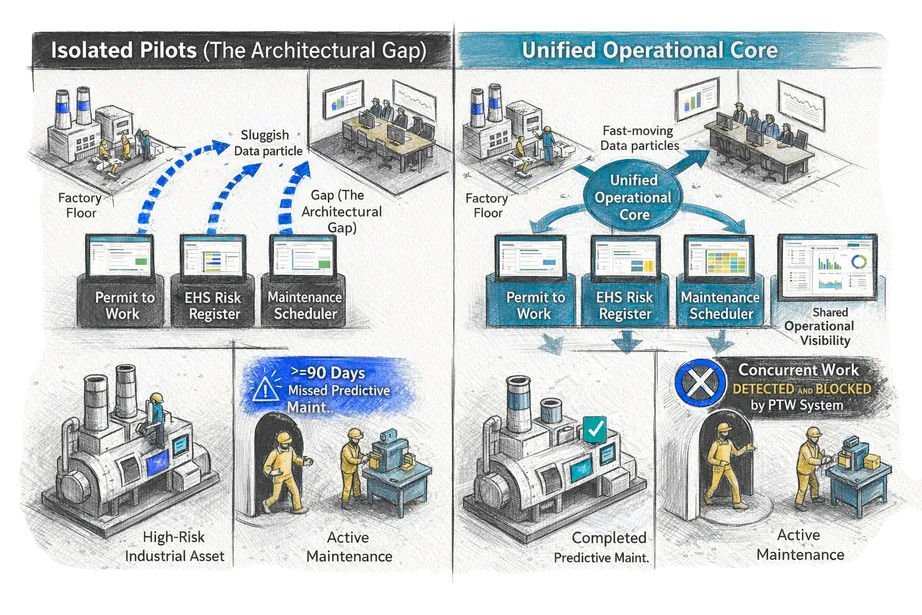
The gap was not procedural. The site’s ISO 45001-aligned and locally compliant procedures were current. Its HAZOP documentation was complete. Its incident investigation methodology was ISO 45001-compliant. The gap was architectural — a structural absence of integration between the systems that generated safety data and the systems that ran the factory.
Root Cause: EHS operated as a reporting function downstream of operations, not as an embedded intelligence layer within them. The result: correct data, captured too late, visible to too few.
This is not an anomaly. Analysis of WEF (World Economic Forum) Lighthouse applications from recent cohorts indicates that ‘pilot purgatory’—the phenomenon cited by the WEF where digital transformation fails to move beyond isolated pilots—disproportionately affects EHS functions. The reasons are consistent across sectors: EHS data is generated at the operational layer but reported at the management layer, with no real-time conduit between the two.
For this site, the business consequence was measurable. Two high-risk assets had not received predictive maintenance assessments in over 90 days — not due to resource failure, but because the maintenance scheduler and the EHS risk register had no shared visibility. The Permit to Work system could not confirm, in real time, whether a confined space entry was occurring concurrently with a planned maintenance intervention on an adjacent line. These were latent failure conditions whose detection depended on delayed cross-functional visibility. They were conditions in which a failure would not be detected until after it occurred.
The Standard: What WEF Lighthouse ⇲ Designation Actually Demands of EHS
The WEF (World Economic Forum) Global Lighthouse Network, which as of January 2026 spans 223 designated sites across more than 30 countries and 40 industries, evaluates manufacturers against five concurrent pillars: productivity, supply chain resilience, sustainability, customer centricity, and talent. EHS is not a standalone criterion. It is embedded across all five — and that is precisely what makes it difficult to address in isolation.
Lighthouse designation is not awarded to facilities that have solved safety. It is awarded to facilities where safety, sustainability, and operations have become indistinguishable.

The 2025 assessment cohort was notable for introducing the requirement of what WEF (World Economic Forum) assessors define as ‘cognitive networks’—the expectation that data generated at the asset level flows, in real time, to decision-makers across the value chain. For EHS leaders, this represents a fundamental shift in what is being measured. It is no longer sufficient to demonstrate that incidents are investigated thoroughly, or that emissions data is audit-ready by quarter-end. The question is whether that data is live, integrated, and actionable at the moment it is needed.
| Lighthouse Pillar | The 4IR Operational Benchmark | The Architectural Blind Spot (Common Gap) |
|---|---|---|
| Productivity | Predictive asset health data automatically triggers and restricts EHS permit workflows to prevent concurrent risks. | Maintenance and EHS operate in disconnected systems, creating invisible failure conditions on the floor. |
| Sustainability | Live Scope 1 & 2 energy telemetry is integrated with production logic; Scope 3 supplier tracking is automated. | Emissions data is manually assembled post-production, preventing real-time energy optimization. |
| Talent | Frontline workers are augmented with connected, mobile access to real-time hazard data and interactive safety protocols. | Reliance on static, paper-based permits and procedures delays hazard response and limits workforce autonomy. |
| Supply Chain Resilience | Live supplier EHS and sustainability risk profiles are embedded directly into procurement routing decisions. | Supplier ESG data is trapped in static compliance portals, invisible to active supply chain planners. |
| Customer Centricity | Environmental footprints are traceable to specific production batches, enabling verifiable "Digital Product Passports." | Disconnected production and energy data makes it impossible to prove precise product-level sustainability to buyers. |
The implications for EHS functions are significant. A team that has built its credibility on rigorous incident investigation, thorough permit management, and compliant sustainability reporting may find itself structurally excluded from Lighthouse evaluation — not because its standards are insufficient, but because its data is not connected to the systems the assessment actually examines.
The Precedent for Integration: The demand for operational coherence is not theoretical; it is a proven prerequisite for Lighthouse designation. Facilities that have recently achieved Advanced or Sustainability Lighthouse status—such as Henkel’s Düsseldorf facility and Schneider Electric’s Le Vaudreuil plant—secured their designations by establishing “Digital Twins” and unified IIoT data layers. In these WEF-recognized facilities, energy, safety, and production data are no longer siloed; they act as a single, real-time digital thread. The Sparrow IndustryOS® methodology mirrors this exact, validated architectural standard.
Intervention: Integrating EHS ⇲ into the Operational Core
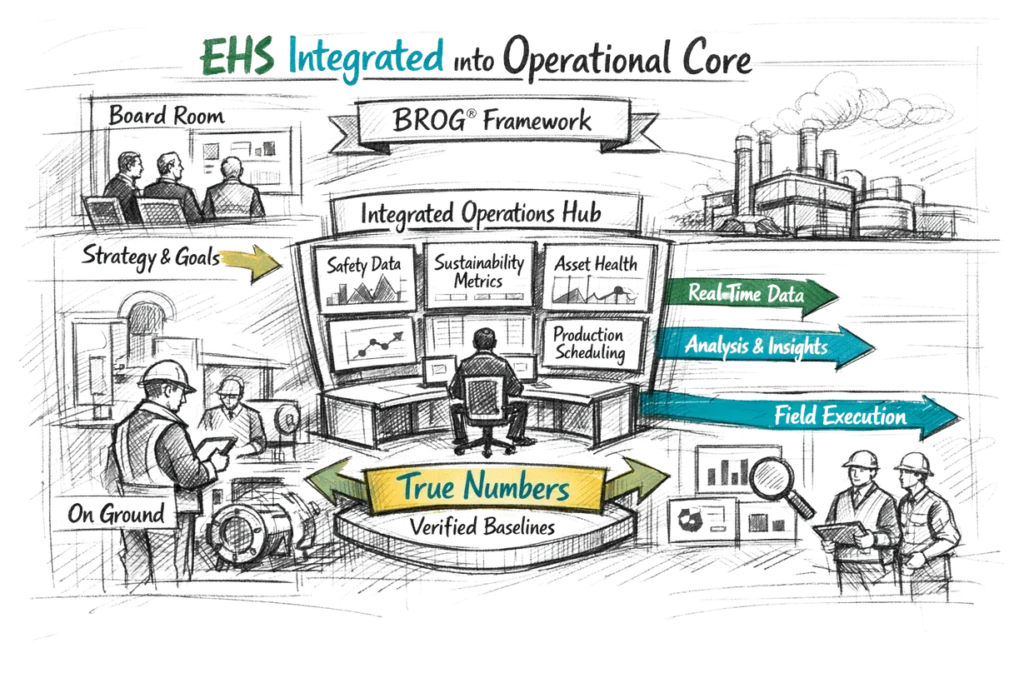
Following the initial Lighthouse gap assessment, the site initiated a structured digital integration programme. The objective was not to replace existing EHS management systems but to connect them — to create a unified operational layer in which safety data, sustainability metrics, asset health, and production scheduling shared a common real-time foundation.
The programme was structured using the BROG® (Board Room to On Ground) framework — a methodology that explicitly addresses the gap between high-level transformation mandates and on-ground execution. Rather than beginning with technology deployment, the framework required the site to first establish what it called ‘true numbers’: verified operational baselines that reflected actual conditions, not reported conditions.
Phase 1 ⇲ — Report: Establishing the Actual Baseline
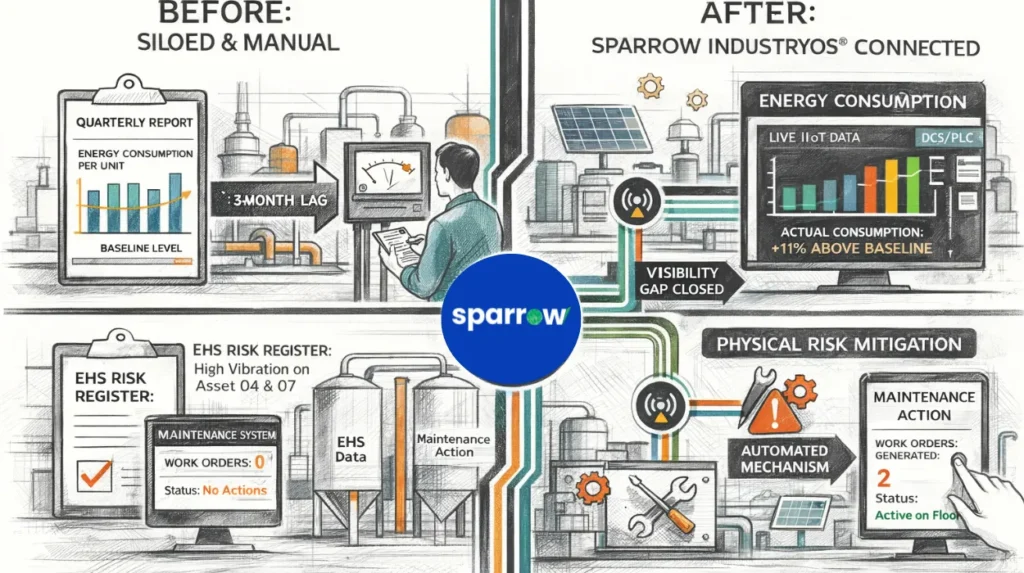
When IIoT sensors were connected directly to the site’s PLCs and DCS systems via Sparrow IndustryOS®, the live data diverged materially from the previously reported figures. For example, actual energy consumption per unit was running 11% above the reported baseline. This was not a case of deliberate misreporting; it was the direct consequence of the visibility gap—the natural lag between manual meter readings and quarterly reporting cycles.
Similarly, the siloed architecture masked physical risks. The EHS risk register had accurately noted elevated vibration readings on two safety-critical assets, yet neither had open work orders in the maintenance system. The data existed, but without an automated mechanism to translate an isolated EHS notation into a live maintenance action, the risk remained active on the floor.
The site’s reported EHS performance was accurate as of its static reporting date. However, its actual operational condition, in real time, was materially different. The blind spot between those two states is where incidents originate.
Phase 2 ⇲ — Assure: Standardising Data Integrity Across Functions
The Assure phase addressed what the framework identifies as ‘organisational myopia’—the distortion of operational reality caused by delayed, function-siloed reporting. Standardised data protocols were established across maintenance, EHS, production, and sustainability functions, ensuring that every number presented to regulators, corporate leadership, or a WEF (World Economic Forum) assessment panel could be traced to a single, verified source.
For the EHS function specifically, this phase eliminated the three-week quarterly reporting cycle. Scope 1 and Scope 2 emissions were visible in real time, drawn directly from energy monitoring integrated with the DCS. Permit to Work status was accessible to production schedulers, removing the structural blind spot in which maintenance interventions and confined space entries had previously been invisible to each other. For WEF assessors, this architectural shift represents the definitive line between a conventional factory and a Lighthouse. A facility cannot demonstrate 4IR maturity if its risk and sustainability data are retrospective. By establishing a single digital truth, the site fundamentally transitioned EHS from a lagging compliance requirement into a leading operational control—the exact threshold for Lighthouse recognition.
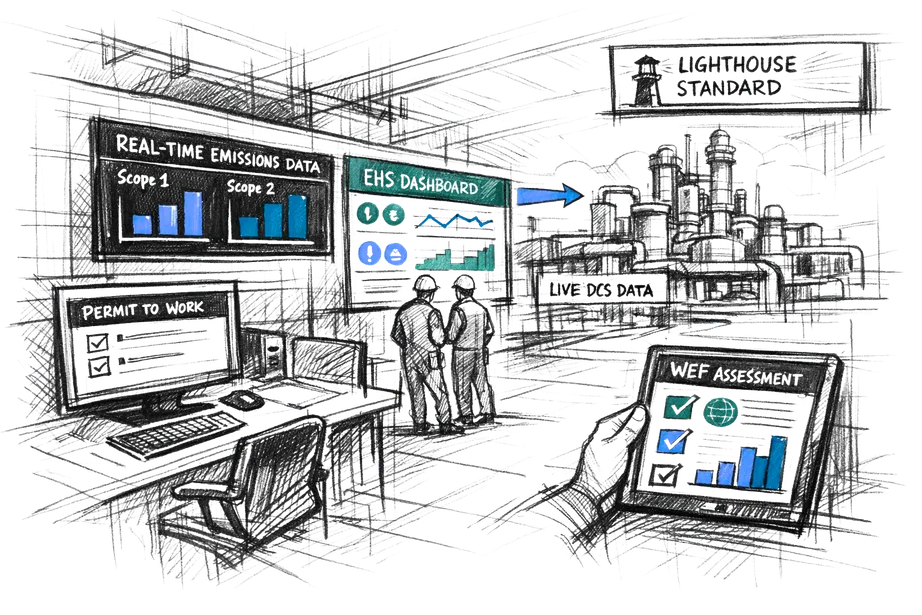
Phase 3 — Target: Aligning Corporate Mandates with Site-Level Accountability
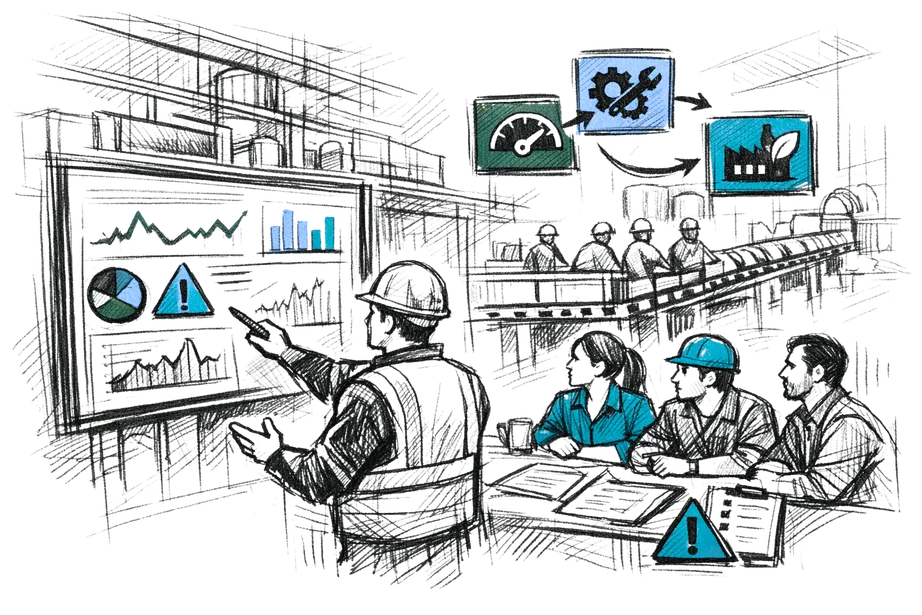
The Target phase established the connection the site had previously lacked: between the executive team’s Lighthouse ambition and the operational decisions being made on the shop floor every shift. Using the platform’s integrated dashboards, EHS leaders were able to demonstrate — in live operational data — how specific production decisions translated into environmental exposure, maintenance risk, and sustainability trajectory.
This changed the nature of EHS participation in operational meetings. Rather than presenting lagging indicators from the previous period, the EHS function was contributing real-time risk assessments to production planning decisions. Maintenance scheduling, line speed changes, and supplier substitutions were evaluated against their EHS implications before implementation, not after.
The function stopped being a reporter of past incidents and became a navigator of future risk. That is the shift Lighthouse assessment is looking for.
Phase 4 — Progress: Measurable Operational Outcomes
The integration of predictive maintenance with EHS risk monitoring produced the most operationally significant results. To bridge the gap between abstract data and physical plant realities, the platform introduced Sparrow IndustryOS®‘s proprietary iLOL (Information Layered Over Layout) architecture, which maps live telemetry onto asset topology using engineering drawing references and equipment hierarchy metadata. By overlaying live sensor telemetry directly onto digital P&ID diagrams, the system contextualised anomalies within the physical topology of the facility. When a time-series deviation appeared on a discharge line sensor, the AI did not simply trigger an alert — it queried the digital P&ID, identified connected assets and their current operational status, and cross-referenced the deviation against the manufacturer’s performance envelope. The classification — sensor drift versus mechanical degradation — was delivered in minutes rather than hours.
From an EHS perspective, the consequence was concrete: safety-critical assets were no longer inspected periodically. They were monitored continuously, with risk escalation built into the same workflow that governs maintenance scheduling and production planning.
Operational & Environmental Impacts: Sparrow IndustryOS® ⇲ & BROG® ⇲ framework
Post-integration outcomes reflect a continuous 6-month operational measurement period following deployment. Pre-integration baselines were established using the facility’s audited historical records and manual logs.
Confined Space Entries
(Reactive)
(Reactive)
ZERO
Pre: Avg. 12 reactive entries/quarter (Manual visibility)
Post: 6 months post-implementation
Post: 6 months post-implementation
Machine Downtime
(Unplanned)
(Unplanned)
44%
Reduction
Pre: 320 hrs/mo (Corrective maintenance model)
Post: EHS risk flags in works orders
Post: EHS risk flags in works orders
GHG Reporting Cycle
REAL - TIME
Pre: Quarterly manual data assembly (3 weeks)
Post: Live DCS integration, Scope 1 & 2
Post: Live DCS integration, Scope 1 & 2
Scope 3 Emissions Tracking
AUTOMATED
Pre: Annual manual supplier data
Post: 15 categories tracked automatically
Post: 15 categories tracked automatically
Permit to Work (PTW) Visibility
INTEGRATED
Pre: Paper-based, no links
Post: Digitized, MES integrated, flagged concurrent Work
Post: Digitized, MES integrated, flagged concurrent Work
Energy Consumption Accuracy
0% VARIANCE ✓
Pre: 11.1% reported vs. actual variance ($1.2M cost exposure)
Post: Live monitoring eliminates variance
Post: Live monitoring eliminates variance
Outcome: What Designation Actually Confirmed
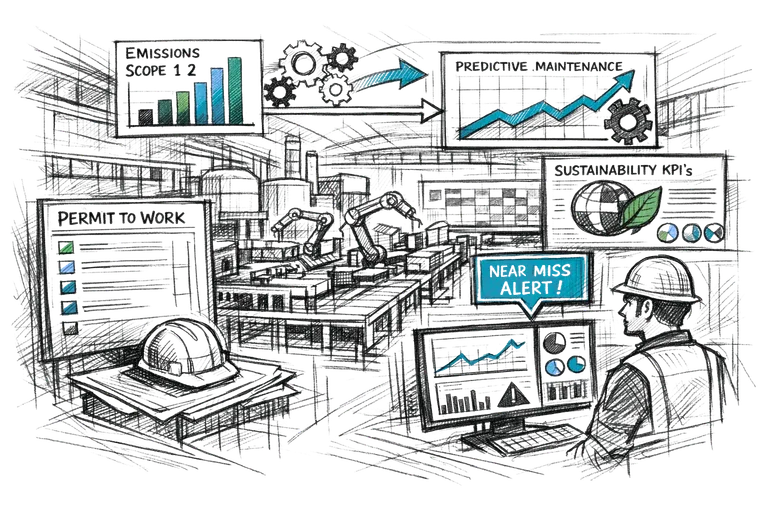
The site received WEF (World Economic Forum) Global Lighthouse designation 13 months after initiating the integration programme. The assessors’ feedback identified operational coherence as the distinguishing characteristic — specifically, the degree to which EHS had ceased to function as a parallel management system and had become embedded in the operational decision layer.
The citation language is worth noting precisely because it describes the condition most EHS leaders do not currently have: Permit to Work issuance integrated with production scheduling; near-miss data feeding directly into the predictive maintenance model; Scope 1, 2, and 3 emissions tracked at the line and SKU level; sustainability managed as a live operational parameter rather than a quarterly reporting obligation.
The broader implication is structural. EHS functions that have been built around lagging indicator management, periodic audit cycles, and function-siloed data are not failing at EHS. They are operating an EHS architecture that is incompatible with the integration standard Lighthouse assessment applies.
The transformation this site underwent was not primarily a technology
implementation. It was a repositioning of EHS from a reporting function to an operational intelligence function — one that generates live operational visibility data, participates in live operational visibility decisions, and is hed accountable against real-time outcomes.
Assessment Citation: The site demonstrated that EHS was not a compliance layer applied over operations — it was a continuous intelligence function embedded within them. This reflects the operational model increasingly associated with Global Lighthouse-level performance.
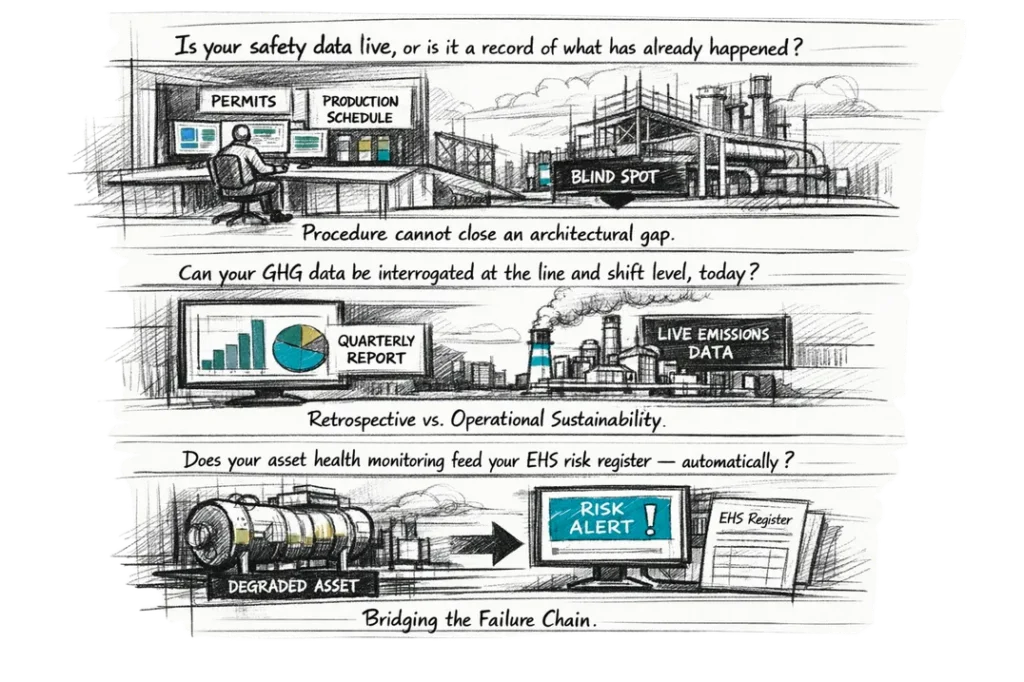
Implications: A Diagnostic for EHS Leaders
The following are not aspirational questions. They are the criteria against which Lighthouse assessors evaluate whether an EHS function is operating at the integration standard the framework requires. Each represents a structural condition — one that either exists in your facility or does not, and that no procedural improvement will resolve if the underlying architecture is not in place.
1. Is your safety data live, or is it a record of what has already happened?
If your Permit to Work system does not have live operational visibility visibility into production scheduling, and your production scheduler does not have real-time visibility into active work permits, you have a structural concurrent-work blind spot. Procedure cannot close an architectural gap.
2. Can your GHG data be interrogated at the line and shift level, today?
Quarterly sustainability reporting is a record of performance. Lighthouse-level sustainability management is a live operational capability. If your emissions data is assembled after the fact, your sustainability claim is retrospective, not operational. It will not satisfy the WEF’s end-to-end criterion.
3. Does your asset health monitoring feed your EHS risk register — automatically?
The dominant precursor pattern in major industrial incidents is asset deterioration that was detectable but not connected to a risk escalation pathway. Predictive maintenance platforms that do not integrate with EHS risk management are safety tools with a gap in the most critical part of the failure chain.
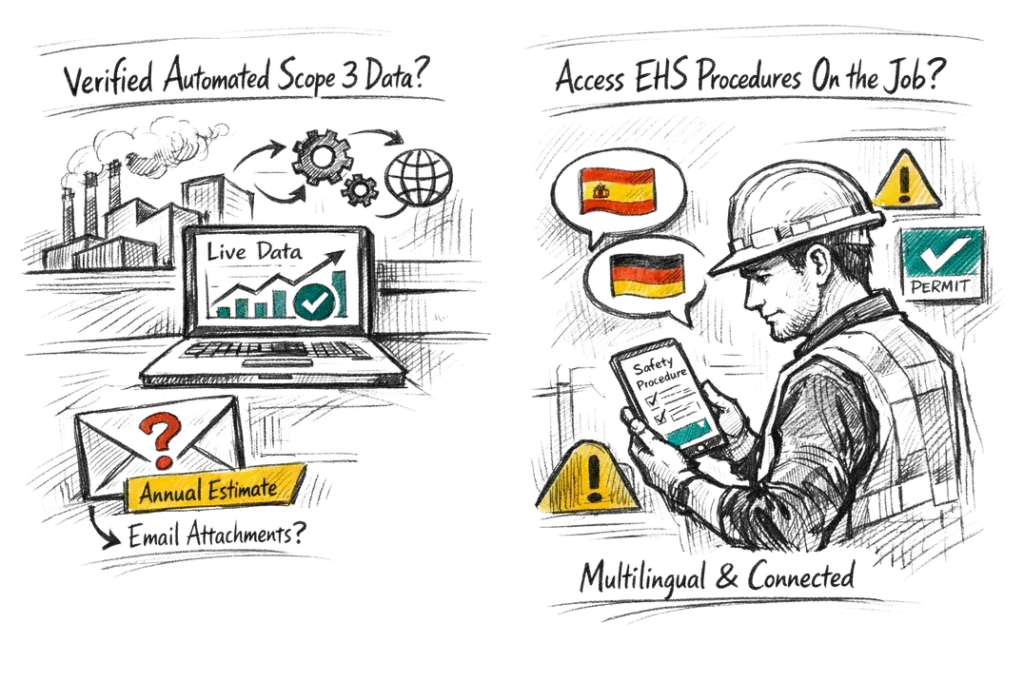
4. Do your Scope 3 emissions have a verified, automated data source?
Manual Scope 3 collection is an annual estimate, not a measurement. The WEF Sustainability Lighthouse criterion requires end-to-end value chain accountability. If supplier emissions data arrives by email attachment once a year, your Scope 3 footprint is a modelling exercise, not an operational figure.
5. Can a frontline worker access the correct, current EHS procedure — in their language — on the device they are holding?
The 2025 Lighthouse cohort is defined by people-centric operations. Connected worker capability — multilingual, device-agnostic, integrated with live permit and procedure systems — is no longer a digital innovation. It is a baseline qualification for workforce Lighthouse criteria.
The Integration Threshold: If more than two of these conditions are not currently met, your EHS function is operating below the integration standard that Lighthouse assessment applies — regardless of your incident rates, audit scores, or reporting compliance.
Closing Observation
The WEF (World Economic Forum) has been explicit in its 2025–2026 assessment guidance: the Lighthouse Network is not recognising facilities that have completed a transformation. It is recognising facilities that have built a continuous transformation capability. The distinction matters because it shifts the question an EHS leader should be asking.
The question is not: has our EHS function performed well this year? The question is: is our EHS function structurally capable of participating in the kind of real-time, integrated decision-making that the next ten years of operational excellence will require?
For the facility described in this case study, the answer — before the integration programme — was no. Not because the EHS team was underperforming. Because the architecture in which they were operating made it structurally impossible for their work to be seen in real time, connected to operational decisions continuously, or evaluated against live operational outcomes.
The gap this site closed was not a performance gap. It was a visibility gap. And in a Lighthouse assessment, an EHS function that is not visible in the operational data layer is difficult for Lighthouse assessment to recognise as integrated capability.
Deep Technology | Consulting | Solutions
Comments are closed.