
Optimizing Quality Variables in Chemical Manufacturing: IndustryOS®
Optimizing Quality Variables in Chemical Manufacturing: IndustryOS®
A Case Study on Quantum Thinking and IndustryOS® Architecture
The Challenge: Unstable Quality in a High-Stakes Process
Global Chemical Solutions Inc. faced persistent challenges in optimizing product quality for their high-value polymer line. Key quality variables, primarily purity and viscosity, showed high variance across production batches. This instability led to significant material waste, costly reprocessing, and difficulty in meeting premium market demands. The core issue was the immense complexity of the production process, involving over 500 interacting variables.
The initial production data (Q3) revealed that over 60% of batches failed to meet the prime 99.0% purity target, resulting in significant value loss.
The Classical Bottleneck
Classical optimization solvers (like gradient descent and simulations) were employed but proved insufficient. The sheer number of variables created an optimization landscape with countless “local optima” — solutions that seemed good but were not the true *best* solution. The classical computers would get “stuck” in these suboptimal valleys, unable to find the global optimum that would maximize quality.
This chart conceptualizes the problem: classical methods (red dot) found a “good” solution (local optimum) but failed to find the “best” solution (global optimum, green dot) in the vast search space.
The Sparrow Infinity Quantum Solution
Sparrow Infinity introduced a “Quantum Thinking” methodology to reformulate the problem. Instead of a brute-force simulation, the team identified the core interacting variables and mapped their relationships to a Quadratic Unconstrained Binary Optimization (QUBO) problem. This industry-specific model was then solvable by quantum annealing hardware, which excels at finding the global minimum in complex systems.
1. Identify 500+ Interacting Process Variables
↓
2. "Quantum Thinking": Model Inter-dependencies
↓
3. Formulate as QUBO Problem
↓
4. Solve on Quantum Annealer
↓
5. Identify Global Optimum (Ideal Settings)
Comparative Performance: Classical vs. Quantum
A head-to-head comparison was conducted between the existing classical solver and the new Sparrow Infinity quantum model. The quantum annealer was able to explore the entire variable search space simultaneously, finding a certifiably optimal set of parameters in a fraction of the time. The classical solver, running for 24 hours, was still unable to match the quality of the solution found by the quantum annealer in under 30 minutes.
The quantum approach delivered a significantly higher-quality solution (99.8% optimal vs 92.5%) in a fraction of the time, while exploring 100% of the relevant problem space.
Breakthrough Results: The Impact of Optimization
By implementing the new process parameters identified by the Sparrow Infinity quantum model, Global Chemical Solutions Inc. achieved unprecedented stability and quality in their polymer line.
Average Product Purity
0
%
Reduction in Material Waste
0
%
Faster Problem Resolution
0
X
The Paradigm Shift: From Newtonian Mechanics to Quantum Complexity in Industrial Operations
The chemical manufacturing industry currently stands at a precipice of transformation that is far more fundamental than the mere adoption of new digital tools. For the better part of a century, the operational philosophy governing chemical plants—from petrochemical refineries to specialty polymerization units—has been rooted in a “Newtonian” worldview. This perspective, inherited from the Scientific Management principles of Frederick Taylor and the deterministic physics of the 19th century, views a manufacturing facility as a “clockwork” mechanism. In this model, the facility is an aggregation of discrete, independent parts—pumps, reactors, heaters, and operators—that interact in linear, predictable ways. The prevailing assumption is that if one can optimize each component individually and control the inputs with sufficient precision, the outputs will be deterministic and flawless.
However, the empirical reality of modern chemical manufacturing, particularly in complex processes such as Styrene Polymerization, fundamentally contradicts this mechanistic simplification. A chemical reactor is not a machine; it is a complex adaptive system (CAS) characterized by non-linearity, chaos, and deep interconnectedness—traits that align far more closely with the principles of quantum mechanics than classical physics

The failure to recognize this distinction has led to a systemic crisis in the industry, manifested in persistent inefficiencies, off-specification (off-spec) production, energy waste, and unpredicted safety incidents.
This report presents an exhaustive case study on the application of “Quantum Thinking” and related advanced computing architectures to resolve these intractable optimization problems. We specifically examine the ecosystem provided by Sparrow Infinity, a global safety and sustainability consultancy, and their flagship IndustryOS® platform.2 By analyzing their architecture, we explore how shifting from a rigid, mechanistic control philosophy to a fluid, quantum-complexity framework—supported by Digital Twins, AI, and eventually hybrid quantum computing—can revolutionize the optimization of critical quality variables.
The Crisis of Complexity and the Newtonian Failure
The limitations of the Newtonian model become painfully evident when applied to the control of quality variables in polymerization. In a classical control loop (e.g., Proportional-Integral-Derivative or PID), the controller assumes a linear relationship between the manipulated variable (such as a cooling water valve position) and the process variable (reactor temperature). This works adequately when the system is at a steady state. However, chemical reactions are dynamic events where “the whole is greater than the sum of its parts.”
The management of these systems has historically been siloed, a direct artifact of reductionist thinking. The Maintenance department optimizes for asset availability, often pushing deferred maintenance to meet production targets.

The Operations department optimizes for throughput, often pushing reactors beyond thermal stability limits. The Quality department optimizes for specification compliance, often rejecting batches that technically meet performance needs but fail rigid, arbitrary criteria. These departments function as isolated “particles,” ignoring the “entanglement” that binds them. A vibration in a feed pump (Maintenance) causes a subtle fluctuation in monomer flow (Operations), which alters the molecular weight distribution (Quality), which eventually impacts the recycling load and energy consumption (Sustainability).
Recent management theory research suggests that to solve these problems, we must adopt Quantum Management Theory, which posits that organizations and systems function like quantum fields—continuously fluctuating, deeply interconnected, and defined by probabilities rather than certainties. In this view, the manager or the control system is not an external operator pulling levers on a machine, but an integral observer whose interactions collapse the probability wave of the plant’s potential futures into a single reality.
Defining "Quantum Thinking" in the Industrial Context
Before discussing hardware or software, we must rigorously define “Quantum Thinking” as it applies to industrial process optimization. It is not merely a metaphor, but a structural framework for designing information architectures, as seen in Sparrow’s IndustryOS®.
Entanglement (Systemic Interconnectedness)
In quantum physics, entangled particles remain connected such that the state of one instantly influences the state of the other, regardless of the distance separating them. In the industrial context, this principle reframes the concept of IT/OT Convergence (Information Technology / Operational Technology).
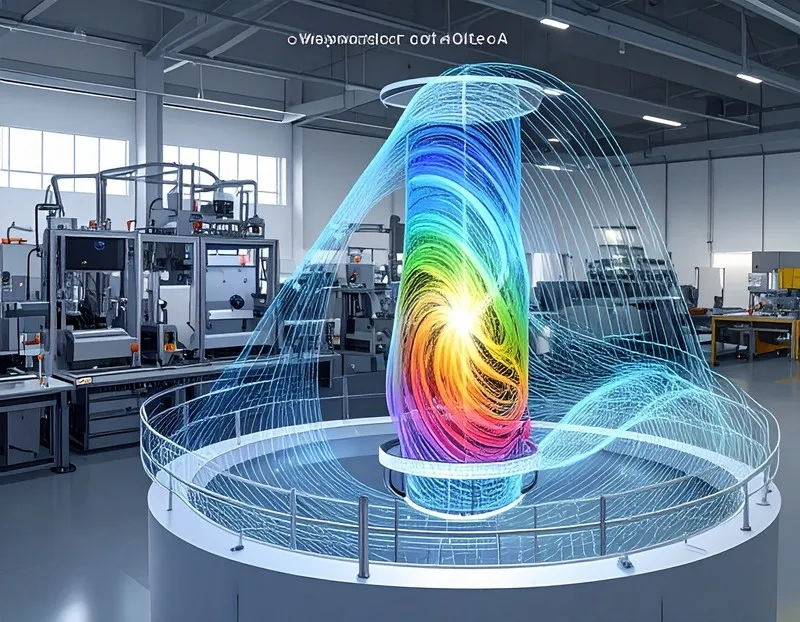
- The Newtonian View: Data is generated in silos. The Distributed Control System (DCS) holds process data; the Enterprise Resource Planning (ERP) system holds financial data. They effectively exist in separate universes, connected only by manual reporting.
- The Quantum View: Every data point is “entangled.” The amperage draw of a reactor agitator is not just an electrical metric; it is simultaneously a proxy for the viscosity of the polymer (Quality), a predictor of bearing failure (Maintenance), and a determinant of the batch’s carbon footprint (ESG). Sparrow’s IndustryOS® architecture facilitates this by creating a unified data fabric where these relationships are mapped and preserved in real-time.
Superposition (The Digital Twin) ⇲
A quantum particle exists in a superposition of all possible states until it is observed. Similarly, a manufacturing process at any given second has multiple potential future trajectories.
- The Newtonian View: Deterministic planning. “We will produce 50 tons of Grade A.” This assumes a single future path and fails when reality diverges (e.g., a raw material impurity slows the reaction).
- The Quantum View: Probabilistic simulation. A Digital Twin—a virtual replica of the physical asset—continuously simulates hundreds of potential futures based on real-time conditions. It holds these scenarios in “superposition,” allowing the control system to calculate the probability of success for each path and select the optimal trajectory to collapse the wave function into the desired outcome.
The Observer Effect (Measurement and Control)
In quantum mechanics, the act of measurement affects the system. In chemical manufacturing, the granularity and latency of data collection fundamentally alter process capability.
- The Newtonian View: Sparse sampling. Lab samples are taken every 4 hours. Between samples, the process is effectively “unobserved,” allowing quality variables to drift into chaos (off-spec) without detection.
- The Quantum View: Continuous, dense observation. By using Soft Sensors (Virtual Metrology) and real-time IoT data, the system is under constant observation. This high-frequency data ingestion, a core capability of Sparrow’s iLOL® (Information Layered Over Layout) technology, essentially “freezes” the process within the desired quality control limits through the Zeno effect of continuous monitoring.

The Physics of the Problem: Styrene Polymerization Dynamics
To understand why Quantum Thinking is necessary, we must perform a deep dive into the specific engineering challenge: optimizing the Molecular Weight Distribution (MWD) in a continuous Styrene Polymerization reactor. This process is the perfect candidate for this case study because it exhibits extreme non-linearity and sensitivity to initial conditions—characteristics that defeat classical linear control strategies.
Chemical Kinetics and Non-Linearity
Styrene polymerization is a free-radical chain reaction. The process involves three principal steps: Initiation (creation of radicals), Propagation (growth of polymer chains), and Termination (death of active chains). The rate of reaction (Rp) is governed by the Arrhenius equation, which introduces exponential non-linearity regarding temperature.
The rate constant k is defined as:

k = A · e-Ea/RT
Where:
- A is the pre-exponential factor (frequency of collisions).
- Ea is the activation energy.
- R is the universal gas constant.
- T is the absolute temperature.
The exponential nature of this relationship means that a minor fluctuation in Temperature (T) does not result in a proportional change in reaction rate; it results in a dramatic, non-linear shift. This sensitivity is compounded by the interplay between the initiation rate (Ri) and the termination rate (Rt).
The Trommsdorff (Gel) Effect: A System at the Edge of Chaos
The most significant challenge in styrene polymerization is the Gel Effect, also known as the Trommsdorff-Norrish effect. As the polymerization proceeds, the conversion increases, and the viscosity of the reaction mixture rises by orders of magnitude.
In a Newtonian fluid, mixing and heat transfer would remain relatively constant. However, the reaction mixture is a non-Newtonian fluid. As viscosity spikes:
- The diffusion of long polymer chains becomes restricted.
- The Termination rate (kt), which relies on two long chains finding each other and colliding, drops precipitously because the chains are “trapped” in the viscous gel.
- However, the Propagation rate (kp) involves small, mobile monomer molecules which can still diffuse easily to the active chain ends.
- Consequently, the rate of chain growth (Rp) explodes while the rate of chain death (Rt) collapses.
- Since polymerization is exothermic (releasing heat), and heat removal efficiency decreases with viscosity, the reactor temperature spikes.
This auto-acceleration leads to a “thermal runaway.” The result is not just a safety hazard; it destroys the quality variable. The high temperature causes rapid, uncontrolled chain initiation, producing a flood of short polymer chains. This broadens the Molecular Weight Distribution (MWD), rendering the plastic brittle and commercially worthless (off-spec).
Classical PID controllers are ill-equipped to handle this. They react to temperature after it has risen. By the time a PID loop detects the temperature spike of the Gel Effect, the kinetic damage to the MWD has already occurred. The controller is reacting to the “echo” of the event, not the event itself.

The "Hidden" Quality Variable: Molecular Weight Distribution (MWD)
The central optimization problem is that the primary quality variable, MWD, is effectively invisible during the process.
- Latency: MWD is typically measured via Gel Permeation Chromatography (GPC) in a laboratory. This process takes 2 to 4 hours.
- Blindness: The plant operators control the reactor based on secondary variables—Temperature, Pressure, and Flow Rate. They operate under the assumption that a stable temperature correlates to a stable MWD.
- The Quantum Disconnect: This is equivalent to navigating a ship by looking at the wake behind it rather than the horizon ahead. The operational reality is probabilistic; operators make adjustments based on experience and intuition, hoping that the unobserved MWD variable remains within the “Goldilocks zone.
This latency and lack of observability create a massive efficiency gap. If a process disturbance (e.g., a feed impurity) alters the MWD, the plant will continue to produce off-spec material for 4 hours until the lab result triggers an alarm. This “blind production” window is the primary source of waste and financial loss in the sector.
The Solution Architecture: Sparrow Infinity & IndustryOS® ⇲
To bridge the gap between the chaotic physics of the reactor and the rigid requirements of the market, a new architectural approach is required. This is where Sparrow Infinity’s IndustryOS® platform serves as the vehicle for Quantum Thinking. The platform is not merely a data historian; it is an integrated operating system designed to create a Digital Twin that mirrors the complex, entangled nature of the physical plant.
The Architecture of Entanglement
IndustryOS® is constructed upon a modular yet integrated framework that aligns with the different dimensions of the manufacturing reality. Unlike legacy systems that use separate software for Maintenance (CMMS), Quality (LIMS), and Operations (MES), IndustryOS® unifies these functions into a single “State Vector” of the plant.
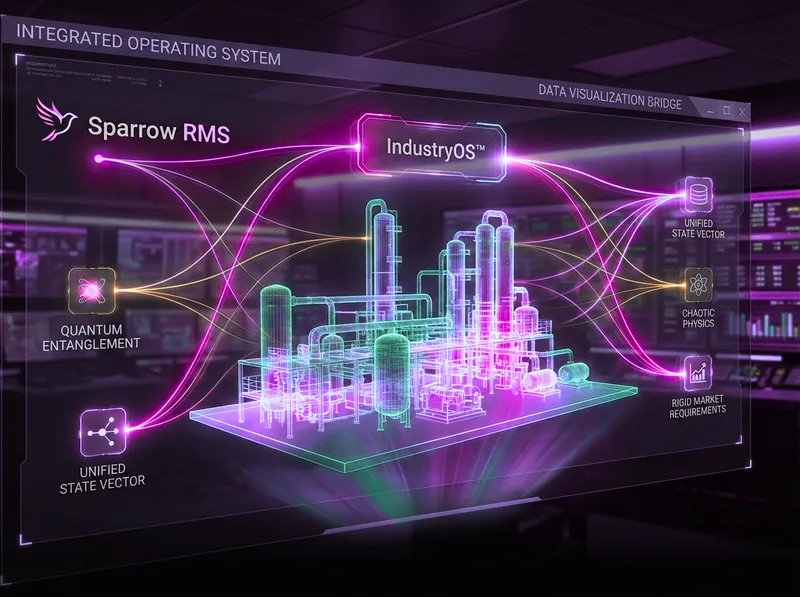
The architecture is comprised of several key modules, each playing a specific role in the “Quantum” optimization strategy:
Module Name
Functionality & "Quantum" Role
Key Features & Integration
IndustryOS® Rock (Data Suite)
The Observer / The Memory. This module forms the foundational data layer. It ingests raw data from the OT layer (PLCS, SCADA) and entangles it with IT data (ERP, Specifications).
- iLoL® Integration: Maps data to physical coordinates.
- Site Shield: Ensures secure, version-controlled data access.
- Universal Data: Standardizes inputs from disparate machine protocols (OPC-UA, Modbus). 11
IndustryOS® Sapphire (Process)
The Hamiltonian / The Simulator. This is the engine of the Digital Twin. It models the process dynamics, workflows, and transformation rules. It predicts the evolution of the system state.
- Collaborated Workflow: Integrates operations, maintenance, and quality workflows.
- AI/ML Analytics: Runs predictive models for quality and throughput.
- Virtual Metrology: Calculates unmeasured variables (like MWD) in real-time. 19
IndustryOS® Ruby (PSM)
The Boundary Conditions. Focuses on Process Safety Management (PSM). It defines the safe operating limits (constraints) within which the optimization must occur.
- Dynamic Risk Assessment: Real-time HAZOP and PSSR integration.
- Management of Change (MOC) (Management of Change): Digitalizes the approval workflow for process changes. 20
IndustryOS® Coral (EHS)
The Environment. Manages the interaction with the external world, specifically Environmental, Health, and Safety compliance.
- Sustainability Tracking: Entangled with process data to calculate emissions per unit of production.
- Incident Management: Tracks near-misses and safety incidents. 20
GroundESG®
The Holistic Accountant. A specialized module for real-time sustainability accounting, treating carbon and energy not as overheads but as direct process variables.
- Scope 1, 2, & 3 Accounting: Real-time calculation based on consumption data.
- Gen-AI Reporting: Automates regulatory disclosures. 4
iLOL® ⇲ : The Spatial Entanglement Engine
A distinctive innovation of Sparrow’s platform is iLOL® (Information Layered Over Layout). In traditional industrial software, data is presented in tabular lists or disconnected trend charts—abstractions that strip data of its spatial context.
iLOL® restores this context by overlaying dynamic data directly onto the visual layout (Digital Twin) of the factory floor.
Contextual Insight: When an operator views the reactor on the IndustryOS® interface, they do not just see a temperature tag. They see the reactor’s physical location, the status of the feed pumps located upstream (spatially), and the location of maintenance personnel currently working in the vicinity.
Quantum Analogy: This mimics the concept of “non-locality” and “field theory.” The operator perceives the reactor not as an isolated variable but as a node in a spatial field of information. This allows for faster, more intuitive decision-making. For instance, if the reactor temperature is spiking, the operator can instantly see if the maintenance team is working on the cooling water valve nearby, linking cause and effect through spatial awareness.
IT/OT Convergence ⇲ : The Fabric of Truth
For the Digital Twin to function as a valid “Superposition” of states, it requires high-fidelity data. The “Rock” module facilitates the convergence of Information Technology (IT) and Operational Technology (OT), effectively collapsing the wave function of data silos.
- Operational Technology (OT): This is the high-frequency data from the shop floor—temperatures, pressures, valve positions, motor currents. It represents the physical reality of the process.
- Information Technology (IT): This is the transactional data—production schedules, raw material batch numbers, cost data, customer specifications. It represents the business reality.
IndustryOS® acts as the universal translator and aggregator. By merging these streams, the system creates a context-rich dataset. The AI doesn’t just know that “Temperature is 150°C”; it knows “Temperature is 150°C while processing Batch #405 of Styrene Grade B, using Initiator Lot #99, destined for Customer X.” This contextual depth is the prerequisite for the advanced “Quantum” optimization algorithms discussed in the following sections.
Quantum Thinking in Action: The Optimization Workflow
Having established the physical problem (Styrene Polymerization) and the technological substrate (IndustryOS® ), we can now detail the methodology of applying Quantum Thinking to optimize the quality variable (MWD). This involves moving from deterministic control to Probabilistic Predictive Control.
From Latency to Virtual Metrology (Soft Sensors)
The first step in the "Sapphire" module is to render the invisible visible. Since we cannot physically measure MWD in real-time, we must construct a Soft Sensor—a mathematical model that infers MWD from available data. This utilizes the Digital Twin capabilities. The Digital Twin of the reactor runs a parallel simulation of the polymerization kinetics. It takes the real-time inputs from the OT layer:
Reactor Temperature Tin, Tout, Tjacket
Agitator Power P – A critical proxy for Viscosity μ.
Monomer Flow Rate Fm
Initiator Flow Rate Fi
Using these inputs, the Twin solves the differential equations of mass and energy balance in real-time to output a Predicted MWD.
MWDpred = f(T, P, Fm, Fi, t)
This transforms MWD from a lagging variable (4-hour delay) to a real-time variable (1-second latency). The system effectively "observes" the MWD continuously, allowing for immediate control actions.
Probabilistic Decision Making
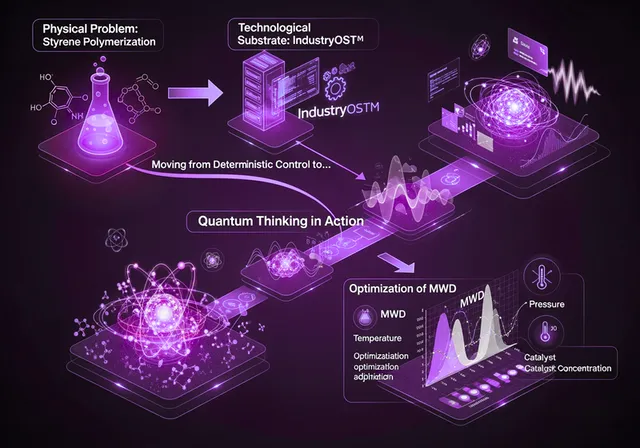
In a Newtonian system, decisions are binary: If T > 150, open valve. In a Quantum system, decisions are probabilistic.
The IndustryOS® AI engine analyzes the state of the reactor not as a single point, but as a probability distribution. It acknowledges the uncertainty in the sensor readings and the stochastic nature of the feed impurities.
- The Prediction: Instead of saying “The MWD is 2.5,” the system says “There is a 95% probability that the MWD is between 2.4 and 2.6.”
- Scenario Analysis: The system runs multiple Monte Carlo simulations into the future (Superposition).
-
- Scenario A: Keep settings constant -> Probability of Gel Effect in 10 mins = 60%.
- Scenario B: Lower Temp by 1°C -> Probability of Gel Effect = 10%, but Yield drops by 0.5%.
- Scenario C: Increase Solvent Flow -> Probability of Gel Effect = 5%, Cost increases by $20.
The system then optimizes for the Expected Value, weighing the cost of off-spec product against the cost of energy and raw materials. This is Risk-Based Optimization, a core tenet of Quantum Management.
Case Study Simulation: Managing the Trommsdorff Effect
Let us simulate a control event in this Quantum-enabled environment to demonstrate the superiority over classical control.
The Event: A subtle drop in the concentration of the inhibitor (TBC) in the styrene feed occurs. This makes the monomer more reactive, pushing the system closer to the auto-acceleration threshold (Gel Effect).
Classical Response (Newtonian):
- The PID controller sees the Temperature is stable at the Setpoint. It takes no action.
- Reaction rate slowly accelerates. Viscosity creeps up.
- Suddenly, the Gel Effect triggers. Heat generation exceeds removal capacity. Temperature spikes.
- The PID controller fully opens the cooling valve, but it is too late. The “runaway” occurs for 10 minutes.
- Result: The batch is ruined (broad MWD). The safety system might trip the reactor (Emergency Shutdown).
IndustryOS® Response (Quantum):
- Detection: The “Rock” module detects a slight increase in Agitator Power (Viscosity) that is disproportionate to the current Conversion rate calculated by the Digital Twin.
- Inference: The AI in “Sapphire” infers a discrepancy in the reaction kinetics. It calculates a high probability that the feed reactivity has changed (Inhibitor drop).
- Prediction: The Digital Twin simulates the next 30 minutes. It predicts a 92% chance of thermal runaway if no action is taken.
- Pre-emption: The system acts before the temperature spikes. It advises the operator (or acts autonomously via MPC) to increase the solvent flow rate slightly to dampen the viscosity rise and lower the jacket temperature setpoint by 2°C.
- Result: The Gel Effect is mitigated. The MWD remains narrow and within spec. The reactor remains stable.
Transformation Roadmap & Business Impact The insights enabled BD to formulate a cohesive transformation strategy:
Phase 1: Create Supply Chain Visibility: Address D2: Horizontal Integration by implementing a cloud-based supply chain control tower to integrate data from key suppliers, providing real-time visibility.
Phase 2: Implement Intelligent Forecasting: To improve D11: Enterprise Intelligence, deploy an AI-powered demand forecasting engine to leverage new real-time data.
Phase 3: Standardize and Scale Automation: Develop a standardized automation playbook based on the best practices from its most mature lines to guide a phased rollout of solutions, targeting improvements in D4: Shop Floor Automation.
Integrating Safety and Sustainability
In this architecture, Safety and Sustainability are not external constraints; they are intrinsic variables.
Dynamic Safety Limits (Ruby Module): As the system detects the feed instability, the “Ruby” module dynamically tightens the safety interlock limits. It might temporarily disable the “Initiator Boost” function to prevent operators from accidentally exacerbating the situation.
Real-Time ESG (GroundESG®): Throughout the event, the “GroundESG®” module calculates the carbon intensity. By preventing the off-spec batch (which would be waste), the system saves the equivalent of tons of $CO_2$ and energy. The system logs this “avoided emission” for the sustainability report.
The Bridge to Quantum Computing (Hardware & Algorithms)
While the current implementation of IndustryOS® relies on “Quantum Thinking” running on classical High-Performance Computing (HPC) or Cloud infrastructure, the architecture is explicitly designed for the transition to true Quantum Computing (QC). The chemical industry is widely predicted to be one of the first beneficiaries of QC due to the inherent quantum nature of molecular interactions.
The Limits of Classical Simulation in Chemistry
Current Digital Twins, no matter how advanced, rely on approximations. Classical computers cannot solve the Schrödinger equation for complex multi-body systems (like long polymer chains) because the computational complexity scales exponentially with the number of electrons.
The Approximation Gap: Classical simulations use “Mean Field” approximations or Density Functional Theory (DFT) which introduce errors. They typically struggle to accurately predict reaction rates for novel catalysts or highly correlated transition states.27 This limits the Digital Twin’s ability to handle “unknown unknowns”—new impurities or new polymer grades.
Hybrid Quantum-Classical Architectures (HQCS)
The future roadmap for Sparrow Infinity and the industry at large involves Hybrid Quantum-Classical Systems. In this architecture, the IndustryOS® platform on the cloud acts as the orchestrator. It handles the heavy lifting of data management, user interfaces, and routine control logic (Classical). However, for specific, intractable problems, it offloads the computation to a Quantum Processing Unit (QPU) accessible via the cloud (e.g., IBM Quantum, D-Wave, or Rigetti).
This creates a symbiotic workflow:
- Classical Loop: IndustryOS® monitors the reactor.
- Quantum Trigger: The system encounters a molecular configuration (e.g., a new catalyst mix) that the classical model cannot simulate accurately.
- Quantum Offload: The problem is encoded and sent to the QPU.
- Quantum Solution: The QPU simulates the ground state energy and reaction pathway.
- Integration: The result is fed back into the Digital Twin to update the kinetic parameters.
Key Quantum Algorithms for Chemical Manufacturing
Several specific quantum algorithms are poised to revolutionize this space.
Variational Quantum Eigensolver (VQE)
VQE is a hybrid algorithm designed for Noisy Intermediate-Scale Quantum (NISQ) computers. It is used to find the ground state energy of a molecule.
- Application: In our Styrene case, VQE could be used to simulate the interaction between the free radical chain end and a specific impurity molecule. This would provide an ultra-precise kinetic rate constant kinhibition for the Digital Twin, eliminating the guesswork in handling feed impurities.
- Impact: This moves the Digital Twin from “Empirical” (based on past data) to “First Principles” (based on physics), allowing the plant to optimize for chemistries it has never run before.

Quantum-Inspired Algorithms: The Bridge
Until fault-tolerant quantum computers are commercially viable, the industry is adopting Quantum-Inspired algorithms running on classical hardware.
- Simulated Annealing: Mimics the physics of annealing to solve optimization problems.
- Tensor Networks: Mathematical structures used in quantum physics that can be applied to machine learning to compress massive datasets and find hidden correlations in high-dimensional process data.
These technologies allow IndustryOS® to deliver “Quantum-like” performance improvements today, preparing the data and the logic for the eventual switch to true quantum hardware.
Strategic Implementation & Future Outlook
The transition to a Quantum-optimized manufacturing environment is not a “plug-and-play” upgrade. It requires a strategic roadmap that encompasses technology, culture, and workforce transformation.
The Roadmap to Quantum Readiness
For a chemical manufacturer, the journey involves three distinct horizons:
• Horizon 1: The Digital Foundation (0–3 Years).
- Objective: Total Data Entanglement.
- Action: Deploy IndustryOS® Rock and Sapphire. Eliminate data silos. Implement iLOL® to visualize the plant’s state. Build the classical Digital Twin.
- Result: Visibility. The plant moves from “Blind” to “Observed.” Variation in MWD is reduced by stabilization.
• Horizon 2: The Probabilistic Shift (3–7 Years).
- Objective: Probabilistic Control and Hybrid Experimentation.
- Action: Implement AI/ML for Soft Sensors. Shift control logic from deterministic to probabilistic. Begin pilot projects with Quantum-Inspired Optimization (Simulated Annealing) for scheduling.
- Result: Predictability. The plant anticipates disturbances. Off-spec production drops significantly.
• Horizon 3: The Quantum Leap (7–15 Years).
- Objective: First-Principles Simulation and Real-Time Quantum Control.
- Action: Integrate Cloud QPUs (Quantum Processing Units) into the workflow. Use algorithms like VQE for real-time molecular simulation of new grades. Use Quantum Annealing for global plant optimization.
- Result: Adaptability. The plant can switch products instantly, handle any feedstock, and operate at the theoretical limits of physics.
Workforce Transformation: The Human Observer
In a Quantum system, the role of the human operator changes fundamentally. They are no longer “machine tenders” turning valves; they become “system architects” and “probability managers.”
Visualization: Tools like iLOL® are critical here. They present complex, multi-dimensional data in a way that aligns with human spatial cognition. The operator sees the “field,” not the “list.”
Empowerment: The “Ruby” and “Sapphire” modules provide decision support (Augmented Intelligence). The system says, “There is a 90% chance of a problem; here are three recommended actions.” The human provides the strategic judgment to select the path.
Upskilling: The workforce must be trained in “Quantum Thinking”—understanding systemic connections, interpreting probabilities, and managing risks rather than just following static procedures.
Comparative Analysis: Results of Transformation
Based on the capabilities of IndustryOS® and the theoretical benefits of advanced control (APC) and quantum optimization, we can project the impact on a typical Styrene Polymerization unit.
| Metric | Traditional (Newtonian) Baseline | Optimized (IndustryOS® / Quantum Thinking) | Improvement Mechanism |
|---|---|---|---|
| MWD Variability ($\sigma$) | 5.2 | 3.1 | Virtual Metrology reduces feedback latency from 4 hours to <1 minute. |
| Off-Spec Production | 4.50% | 0.80% | Probabilistic Prediction anticipates Gel Effect and prevents thermal runaway. |
| Energy Consumption | 1200 kWh/ton | 1050 kWh/ton | Global Optimization avoids overheating and excessive cooling cycles. |
| Reaction Yield | 94.00% | 96.50% | Precise Kinetics allows operation closer to stoichiometric limits. |
| Safety Incidents | 0.5 / year | < 0.1 / year | Dynamic PSM (Ruby) creates real-time safety envelopes. |
| Decision Speed | Hours (Reactive) | Seconds (Proactive) | iLOL® visualization creates immediate situational awareness. |
Conclusion: The Quantum Enterprise
The optimization of quality variables in chemical manufacturing is no longer a problem of “better tuning”; it is a problem of “better thinking.” The sheer complexity of processes like polymerization defies the linear, reductionist methods of the past century. The rigid, Newtonian model of the factory—mechanistic, siloed, and deterministic—is collapsing under the weight of modern efficiency and sustainability demands.
Through the lens of the Sparrow Infinity case study, we see that IndustryOS® provides the necessary architecture to implement Quantum Thinking. By treating the plant as an entangled, probabilistic system and creating a holistic Digital Twin, manufacturers can solve the “wicked problems” of quality variability and efficiency.
The integration of Rock (Data), Sapphire (Process), and Ruby (Safety) creates a unified “State Vector” of the enterprise. The innovative iLOL® technology restores the spatial context necessary for human insight. And crucially, the architecture lays the groundwork for the impending revolution of Quantum Computing, where hybrid algorithms like VQE and QAOA will unlock capabilities currently considered impossible.
For the chemical industry, the path forward is clear. The “Quantum Enterprise” is not a science fiction concept; it is an operational necessity. By adopting these architectures today, manufacturers do not just optimize a reactor; they evolve their entire organization into a complex adaptive system capable of thriving in an increasingly volatile and demanding world.
Deep Technology | Consulting | Solutions
Comments are closed.