
Next-Gen Pharma Safety Engineering Compliance Through Digital & AI-Driven Narratives
Next-Gen Pharma Safety: Engineering Compliance Through Digital & AI Driven Narratives.
Building Safer & Smarter Pharmaceutical Manufacturing
Imagine a modern pharmaceutical factory. Inside the “clean zones,” everything is surgical precision—air filtered so strictly that fewer than 3,500 tiny particles exist per cubic meter. But step into the API (Active Pharmaceutical Ingredient) block, and the “vibe” changes. You smell the sharp, acrid scent of ammonia and the heavy vapor of solvents like toluene. You hear the constant, low-frequency hum of Hastelloy reactors stirring reactive chemicals.
In this high-stakes theatre, the margin for error is zero. For decades, the industry has been haunted by an invisible enemy: the “Manual Drag” of paper-based safety. While the medicine-making technology moved into the future, the systems meant to protect people stayed stuck in the past, buried under a “Mega Mean Mouse” of paper permits and fragmented spreadsheets.
Challenging the "Silent Villains" of Old-School Safety
Before a factory can become a leader in safety, it must defeat the three “Silent Villains” that erode operational integrity:
- The Manual Drag: This is the “traffic jam” of safety. In a paper-based world, getting a permit for high-risk work means hunting for physical signatures across a multi-acre site. This delay isn’t just inefficient; it creates “agitation” that encourages workers to take dangerous shortcuts.
- Siloed Visibility: Valuable safety data often lives on “digital islands”—isolated spreadsheets that don’t talk to each other. If a machine in Plant A is vibrating dangerously, the team in Plant B has no way of knowing until a failure occurs.
- Compliance Exposure: With regulators like the FDA watching every move, a single missing log or illegible signature isn’t just a mistake; it’s a legal liability that can lead to massive fines or shutdowns.

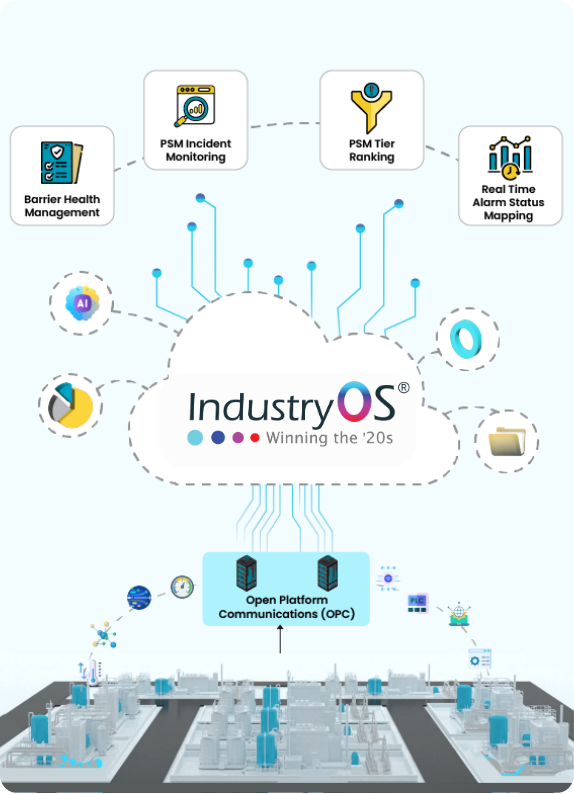
The Hero’s Response: Sparrow Risk Management (SRM), founded in 2014, challenges these villains by deploying IndustryOS®. This is not just software; it is a “Digital Nervous System” that captures every “signal” from the shop floor, processes it with AI, and gives leadership a real-time view of their entire “organism”.
Case Study 1: Silencing the Chaos of "Alarm Floods"
The Brief
A major multi-plant manufacturer of APIs and intermediates operated a complex site with 1,200+ field sensors, solvent distillation units, and large flammable tank farms.
The Problem: A Theatre of Noise
The facility was suffering from “Alarm Floods.” When a single process deviated, it triggered a cascade of alerts, creating a “chaos of noise”. This led to Alarm Fatigue, a psychological state where operators become “desensitized” and start tuning out signals—including the critical ones that indicate a life-threatening leak or explosion.
The Sparrow Intervention
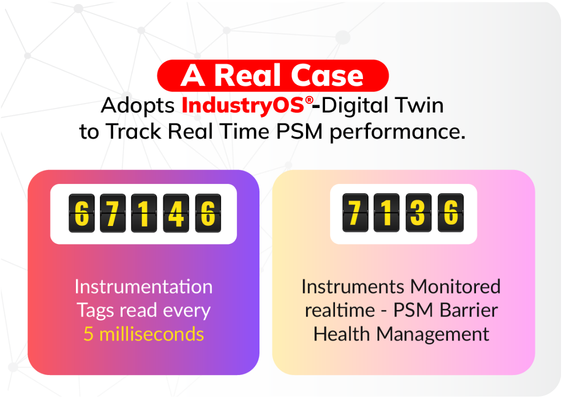
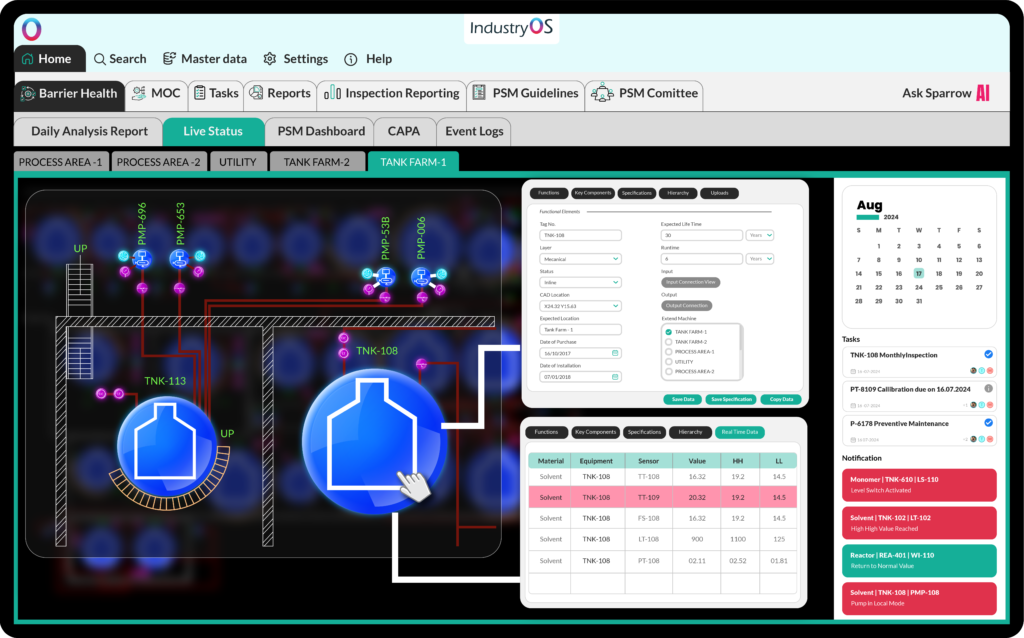
Sparrow implemented the IndustryOS® PSM Platform, a real-time system that acted as a “Digital Twin” of the entire plant. It utilized Alarm Rationalization to filter out 95% of the “nuisance” noise, ensuring that when an alarm sounded, it actually meant something.
Results and Impact: Process Safety ⇲
Performance Improvements After Sparrow Implementation
| Area | Before Sparrow | After Sparrow |
|---|---|---|
| Alarm Flooding |
|
|
| Critical Alarm Response Time | • 6.8 minutes average reaction time | • 2.1 minutes average (69% faster) |
| Interlock Bypass Events |
|
|
| Emergency Plant Shutdowns | • 11 emergency stops/year across 3 sites | • 3 events/year (73% reduction) |
| Tier-3 & Tier-4 Events |
|
|
| Unsafe Conditions Detected |
|
|
| Process Deviations Logged | • <18% deviations captured | • 96% capture rate, fully classified and timestamped |
| Leadership Oversight | • Summary reports shared weekly/monthly | • 100% real-time dashboards, plant-wide |
| Audit Readiness | • Reactive documentation collation | • Always audit-ready, with complete trails & signatures |
Additional Quantified Cultural Improvements
- Near Miss Reporting: Increased from ~15/month to 62/month (4× improvement thanks to transparency).
- Operator Situational Awareness Score (internal KPI): Improved by 41%.
- Safety Conversation Frequency: Monthly safety dialogues increased by 65%.
Few snapshots of our Process Safety Management Modules
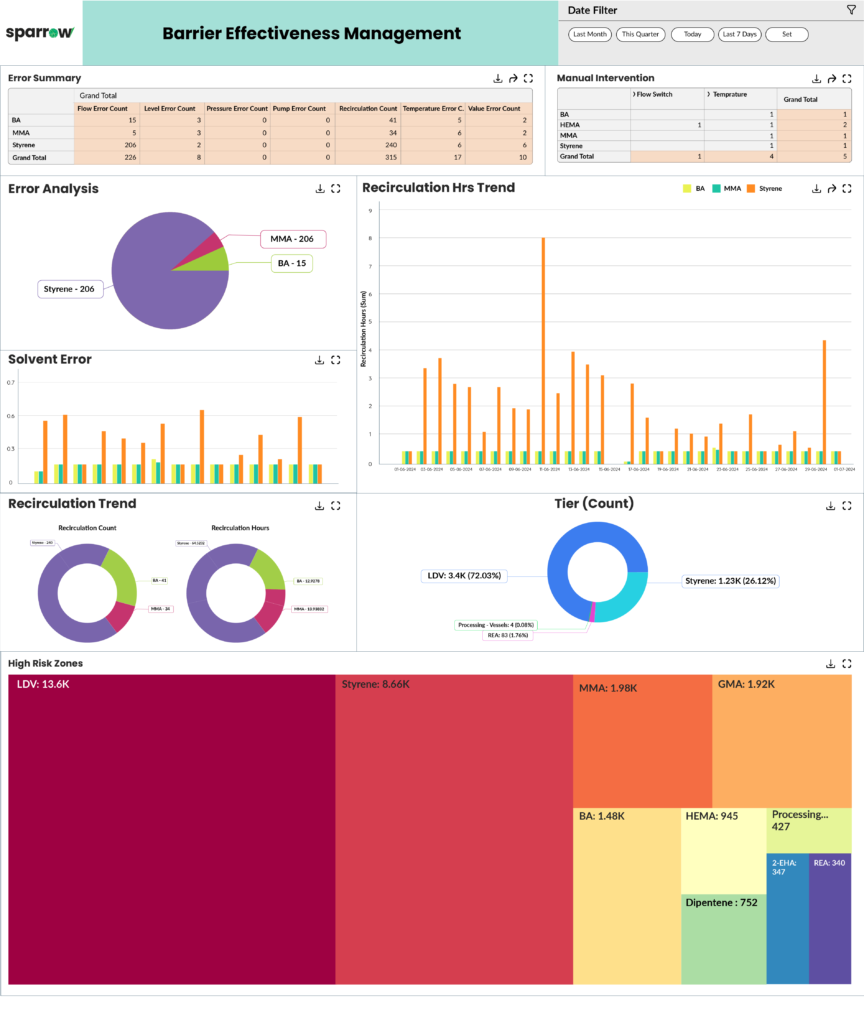
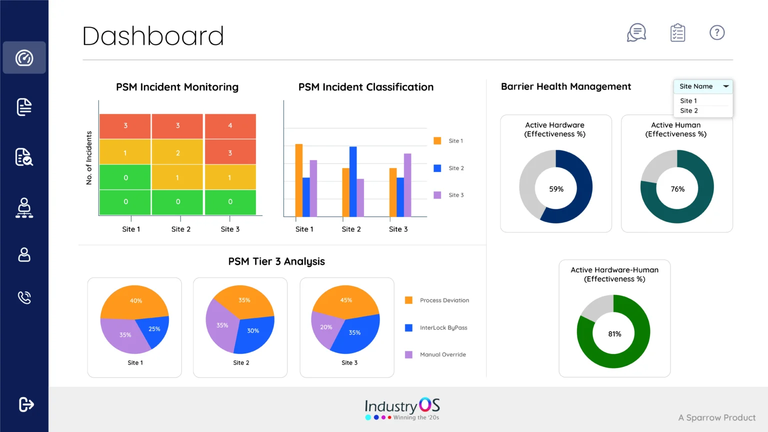
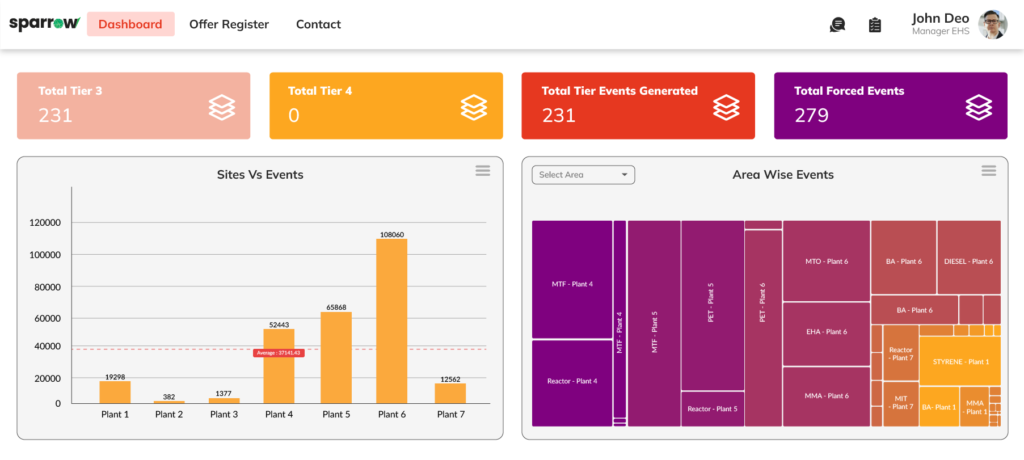
Reduction of Tier 3 - 4 Events & Alarm Flood
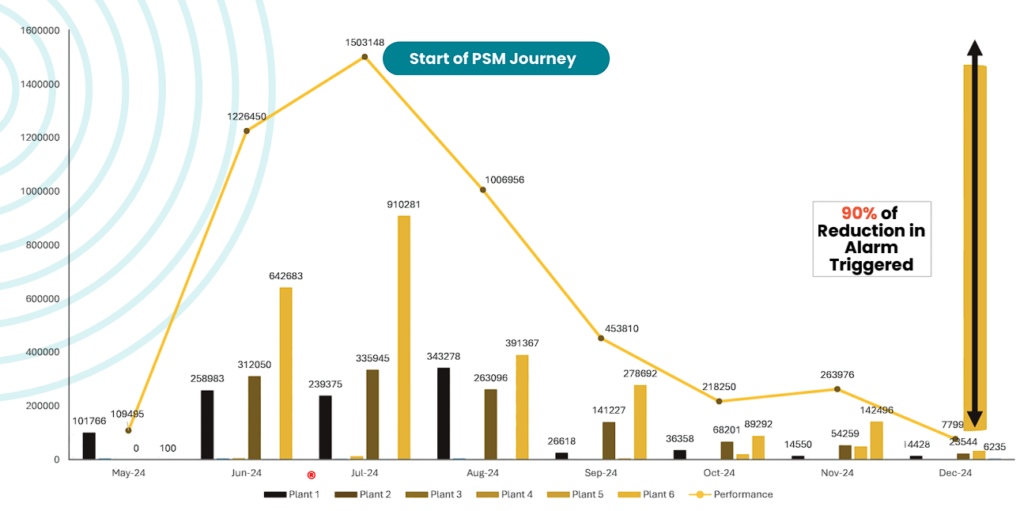
The Cultural & Behavioural Shift
This transformation shifted the mindset from “Responding to Alarms” to “Anticipating Deviations”. Operators gained confidence because they were no longer guessing which alert mattered. This created an “evidence-based” safety culture where every interlock bypass became a point of auditable accountability rather than a hidden risk.

Case Study 2: Ending the Work Authorization Bottleneck
The Brief
A large pharmaceutical organization faced massive complexity with hundreds of contractors performing high-risk maintenance like welding (hot work) and entering confined spaces.
The Problem: A Theatre of Noise
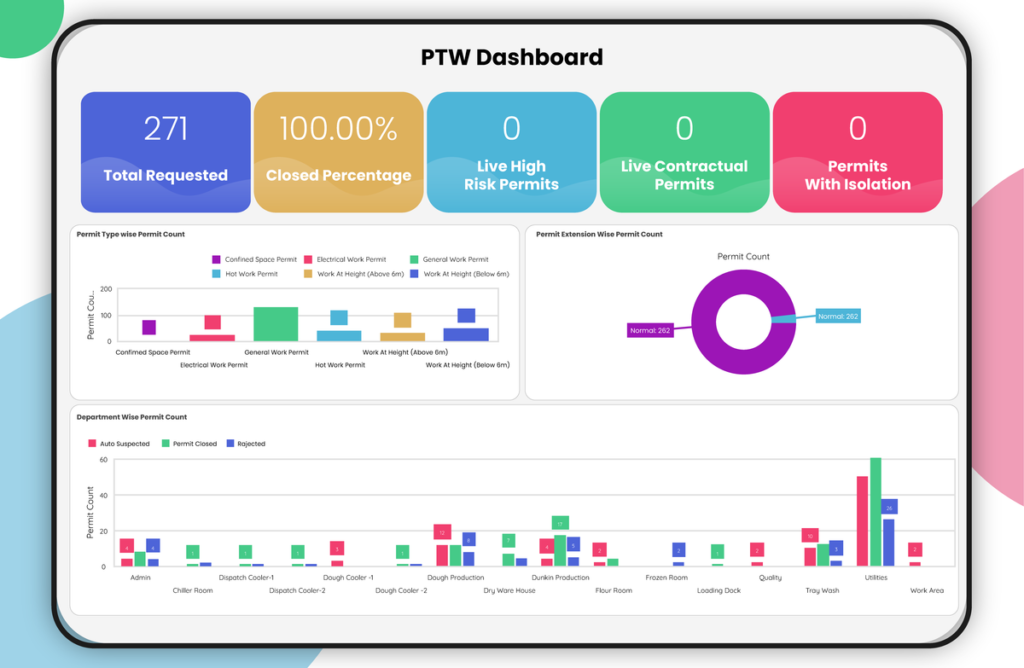
The legacy Permit-to-Work (PTW) process was manual and decentralized. There was zero visibility into “Simultaneous Operations” (SIMOPS). A team could be doing “hot work” (creating sparks) right next to a flammable gas release site because the two departments didn’t have a shared “view” of the facility.
The Sparrow Intervention
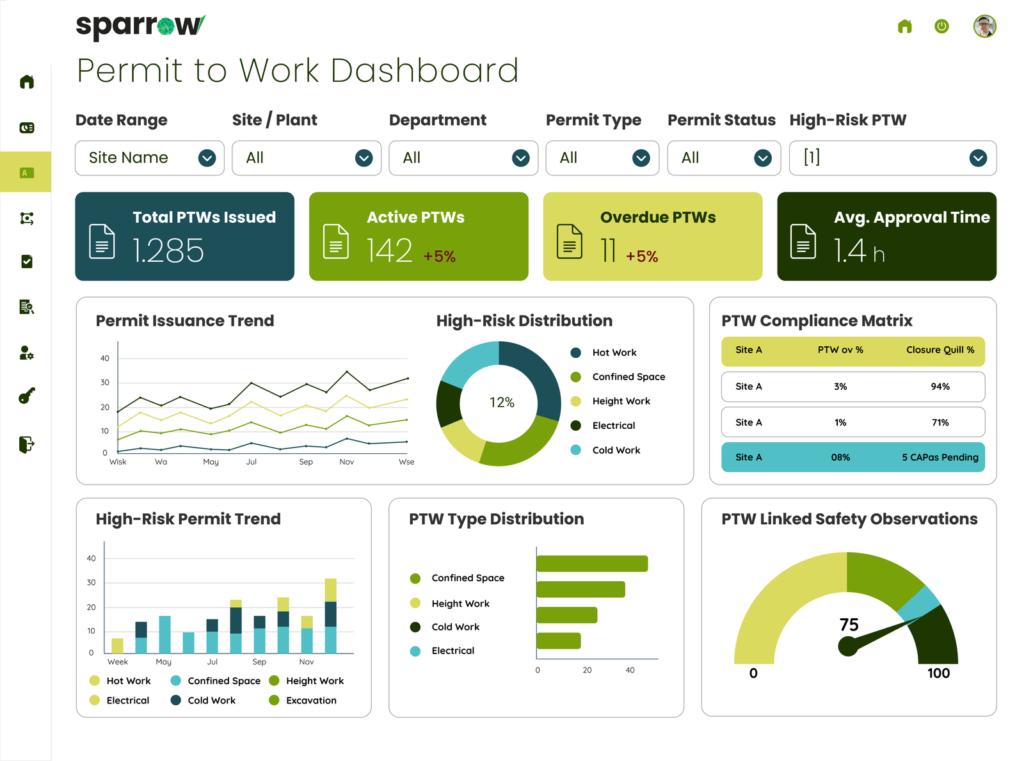
Sparrow launched an AI-Enabled Online PTW system. It used AI to recommend hazards and controls based on historical data, and more importantly, it included Digital Interlocks that automatically blocked conflicting permits in the same zone.
Results and Impact: Work Governance
| Area | Before Digitization | After Digitization |
|---|---|---|
| Permit Traceability | Paper-based, missing or incomplete trails | 100% digital & auditable, with precise timestamps |
| Permit Approval Cycle Time | Avg. 4.5 hours (complex permits up to 9–12 hours) | 1.3 hours avg (71% faster) |
| High-Risk Work Overlaps | No visibility, often discovered late | 98% detection rate using automated conflict rules |
| Control Verification Quality | Verification assumed, often undocumented | 93% controls verified with geo-tagged evidence |
| Permit Violations | Estimated 22–28 violations/month | 5–7/month (73% reduction) |
| Contractor Dependency & Variability | Highly variable permit quality | Standardized risk scoring, 88% consistency |
| Audit Preparedness | Documentation required 2–3 weeks prep | Instant readiness, automated compliance pack |
| Field Safety Reporting Improvements |
|
|
| Closure Delays | Avg. 3.1 hours post job completion | 26 minutes avg (86% improvement) |
Additional Quantified Cultural Improvements
- Supervisor Field Verification Frequency: Increased by 52% using mobile PTW
- Permit Quality Score (internal KPI): Increased from 62% → 93%
- Contractor Compliance Score: Improved by 47%.
The Cultural & Behavioural Shift
Safety conversations shifted from “Is the permit issued?” to “Are the risks controlled?”. Contractors became active participants in a culture of compliance, and leadership gained “Predictive Risk Oversight,” allowing them to stop incidents before the first spark was even struck.
Technical Mastery: GAMP® 5 and the Power of Critical Thinking
In the pharma world, software must be “validated.” Traditionally, this meant an “80/20 paradox”: teams spent 80% of their time on paperwork and only 20% on actual testing. Sparrow uses Computer Software Assurance (CSA)—a shift toward “Critical Thinking”. This “Sugar Coats” the dry data by focusing on the functions that actually impact patient safety and data integrity (ALCOA+).
GAMP® 5 Software Classification
Sparrow launched an AI-Enabled Online PTW system. It used AI to recommend hazards and controls based on historical data, and more importantly, it included Digital Interlocks that automatically blocked conflicting permits in the same zone.
| Layer / Component | PSM & PTW Module Fit | What That Means for Validation |
|---|---|---|
| Hosting & Platform | Category 1 – Infrastructure | Cloud platform/hosting is qualified using supplier assurance and change control. |
| Core Application | Category 4 – Configured | Risk-based testing focusing on high-impact controls like e-signatures and alarm logic. |
| Custom Extensions | Category 5 – Bespoke | Deep design controls for custom AI rules; every line of code is reviewed for safety. |
Conclusion: A Future Without "Mega Mean Mice"
By replacing manual drag with a Digital Nervous System, Sparrow Risk Management ensures that safety is no longer an accident. The factory of the future uses Predictive Risk Intelligence to ensure that every employee returns home safely and every life-saving drug is produced with the highest level of integrity. The era of the “Mega Mean Mouse” is over; the era of Engineering Excellence is here.
Sparrow Risk Management is more than a service provider; we are the architects of industrial resilience. Since 2014, we have served as one of India’s most trusted partners for high-risk, high-scale manufacturing environments, specializing in EHS (Environment, Health & Safety), Risk Management, Sustainability, and Manufacturing Excellence.
With project experience spanning 16+ countries, we don’t just help you comply; we help you build a “Digital Nervous System” that turns fragmented, manual processes into a transparent, real-time command center for safer and more sustainable operations.
Engineering-Led, Management-Driven
What sets Sparrow apart is our ability to integrate rigid management systems with engineering and tech precision. Our philosophy is simple: we help organizations move beyond “reactive firefighting” to achieve measurable, data-driven improvements in safety and risk control.
Our flagship platform, IndustryOS®, is India’s first true manufacturing digitalization enabler. It allows your leadership to lift the “fog of war” from the shop floor, providing structured, real-time visibility across EHS, ESG, and overall operational performance which is backed by Sparrow’s deep consulting expertise that translates insights into executable governance, risk, and performance improvement programs..
Proven at Scale
With a team of 125+ specialized professionals and a track record of 2,500+ successful projects for 600+ clients, Sparrow operates where consistency and reliability are non-negotiable. We bridge the gap between abstract sustainability goals and the visceral reality of the production line.
Two Divisions. One Integrated Vision.
| Aspect | Sparrow RMS | Sparrow Infinity |
|---|---|---|
| Role | Knowledge & Consulting Partner | Digital Transformation Partner |
| Core Focus | Advisory, System Design, and Shielding | Technology Enablement and Digital Weapons |
| Key Offerings |
|
|
| Approach | Engineering-led consulting; deep domain expertise | Modular, scalable EHS & Industry 4.0 software |
| Mode | Hands-on assessments and training | Web & mobile-based "Digital Nervous System" |
| Primary Value | Builds a rock-solid safety foundation | Converts data into real-time decision intelligence |
| Outcome | Robust, defensible, and practical safety systems | Total visibility, faster response, and audit-ready data |
| Best Suited For | Strengthening core safety frameworks | Scaling compliance across multi-plant environments |
Deep Technology | Consulting | Solutions
Comments are closed.